
Plant Encyclopedia

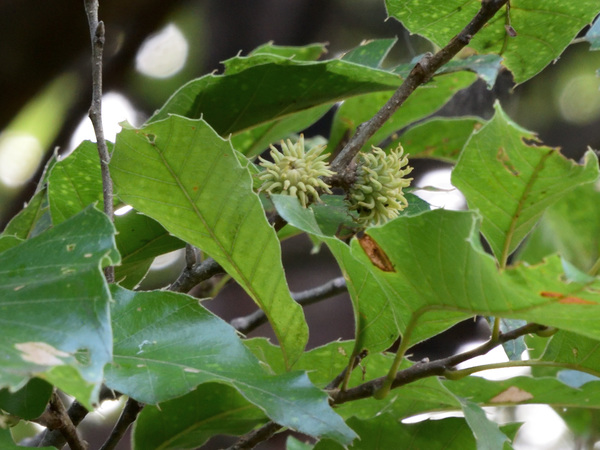
Quercus acutissima (sawtooth oak, "Kunugi")
Japanese name: クヌギ (櫟、橡、椚、栩)
Scientific name: Quercus acutissima
[Overview]
A deciduous tree reaching 15 m in height and 60 cm in trunk diameter.
The bark splits irregularly lengthwise.
Leaves are simple and alternate, oblong-lanceolate, 8–15 cm long, with 13–17 pairs of lateral veins, the tips of which reach the serrations.
The upper surface of the leaf is at first covered with soft hairs, but later becomes hairless and glossy.
The underside of the leaf is at first densely covered with yellowish-brown soft hairs, but later has hairs only sparsely along the veins.
The leaf margin has serrations whose tips extend into awns.
The leaf stalk is 1–3 cm long.
The leaves usually turn yellow in autumn.
There are male and female flowers.
The male flowers form catkins 10 cm long, densely covered with soft hairs, hanging from the lower part of new branches.
The female flowers are borne 1–3 in the upper leaf axils of new branches.
The fruit is a spherical nut (acorn) about 2 cm across, ripening in autumn of the following year.
The cupule (acorn cap) is hemispherical, and the involucre scales are linear, arranged spirally and curved backward, densely covered with short grayish-white hairs.
[Uses]
A representative tree of coppice woodlands, its sap attracts rhinoceros beetles and stag beetles.
The wood is used as bed logs for shiitake mushroom cultivation and as firewood and charcoal material.
The bark is used medicinally, as a tanning agent, and as a mordant.
[Cultivation]
Propagate from seed.
The germination rate drops if the acorns are dried, so sow them immediately or store them kept moist until spring.
It prefers sun, good drainage and fertile soil.
For potted plants, water thoroughly when the soil surface dries; for plants in the ground, rainfall is sufficient.
Apply organic fertilizer as fertilizer in winter and slow-release fertilizer in autumn.
Pests include teppo-mushi (longhorn beetle larvae).
Details
Japanese: クヌギ(櫟、橡、椚、栩)
Translated from our Japanese encyclopedia. If anything differs, the Japanese page is correct.