
Plant Encyclopedia

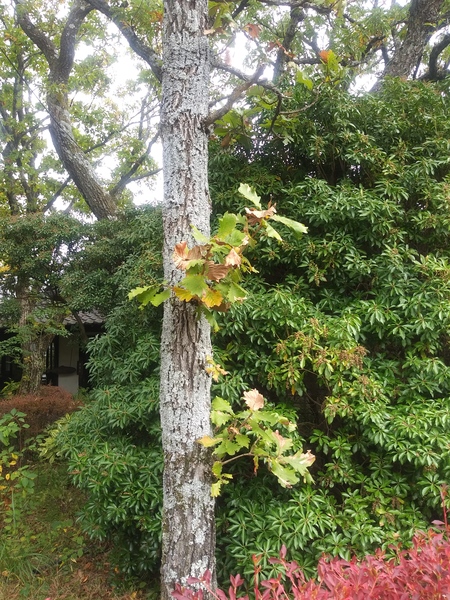
Quercus dentata (Japanese emperor oak, "Kashiwa")
Japanese name: カシワ (柏、檞、槲)
Scientific name: Quercus dentata
[Overview]
A deciduous tree up to 15 m tall with a trunk up to 60 cm in diameter.
It is often found in seaside woods.
The bark develops a thick cork layer and splits irregularly.
The twigs are thick even when young and densely covered with grayish brown short hairs and stellate hairs.
Leaves are simple and alternate, clustered at the tips of the twigs, obovate, 12–32 cm long.
The upper surface of the leaf at first is sparsely covered with short hairs and stellate hairs, but later becomes hairless.
The underside is densely covered with short hairs and stellate hairs, is stiff to the touch, and is grayish brown.
The leaf margin has large, rounded, wavy teeth.
The leaf base is rounded and ear-shaped, and the leaf stalk is very short or absent.
The leaves turn yellow in autumn, and the dead leaves often remain until winter.
There are male flowers and female flowers.
The male flowers form catkins 10–15 cm long, densely covered with soft hairs, and hang in large numbers from the lower part of the new shoots.
The female flowers are borne several at a time in the leaf axils in the upper part of the new shoots.
The fruit is a spherical nut (acorn) about 3–5 cm in diameter that ripens in autumn.
The cupule (acorn cap) is hemispherical, and the involucral scales are linear, arranged in a spiral and curving backward.
[Uses]
The leaves are used to wrap kashiwa-mochi (rice cakes).
The wood is used for firewood and charcoal, bed logs for shiitake cultivation, furniture, and casks for whisky and beer.
The bark contains tannin and was used for tanning leather and as a dye for fishing nets.
It is used in family crests and shrine crests.
[Cultivation]
Propagate from seed.
The germination rate drops if acorns are allowed to dry, so sow them immediately after collecting, or store them kept moist until spring.
It prefers a sunny, airy, well-drained, fertile soil that is slightly moist.
Apply organic fertilizer in winter and slow-release fertilizer in autumn.
[Notes]
The Japanese name derives from kashigu-ha (炊葉, "cooking leaf"); one theory holds that it comes from the leaves being used to wrap rice or lay under it, while another holds that it is a corruption of "hard leaf."
Because the old leaves remain until the new buds appear, it is regarded as an auspicious plant, symbolizing that the family line will not die out.
Details
Japanese: カシワ(柏、檞、槲)、ホソバガシワ(細葉柏)、タチガシワ(立柏)、オオガシワ(大柏)
Translated from our Japanese encyclopedia. If anything differs, the Japanese page is correct.