
Plant Encyclopedia

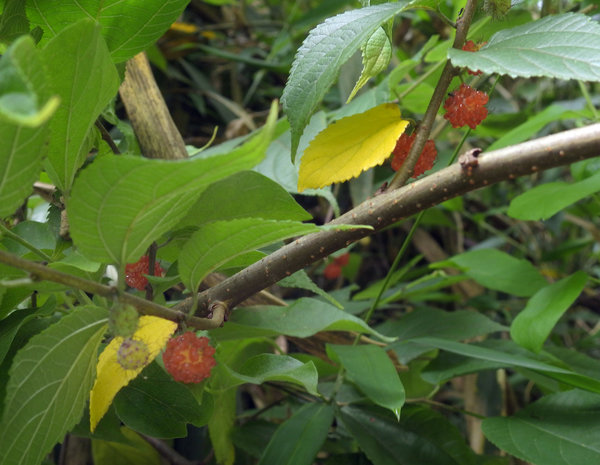
Broussonetia kazinoki × Broussonetia papyrifera ("Kozo")
Japanese name: コウゾ
Scientific name: Broussonetia kazinoki × Broussonetia papyrifera
[Overview]
A deciduous shrub to tree.
It is cultivated, or found in woods near houses.
It is a hybrid of Hime-kozo and Kaji-noki and shows characteristics intermediate between the two.
Most cultivated plants are closer to Kaji-noki and are dioecious.
The young branches have few hairs, the leaves are simple and alternate, and their shape resembles Kaji-noki.
The leaf surface is rough, though not as rough as in Kaji-noki.
The leaf margins have many teeth.
The stipules are lanceolate-oblong.
Almost no fruit is produced.
Plants closer to Hime-kozo are monoecious.
The young branches are densely hairy, the leaves are simple and alternate, broadly ovate and wide like Hime-kozo, with many hairs on the underside.
The leaf stalk is about 1–2 cm long.
The inflorescences are borne singly in the axils of leaves on young branches.
The male inflorescence is cylindrical and bears many small male flowers.
The male flower consists of 4 tepals and 4 stamens.
The female inflorescence is spherical, 1 cm across, and bears many small normal female flowers and sterile female flowers.
The female flower consists of 4 tepals and 1 pistil.
[Uses]
The fibers are tough and are used as a raw material for washi (Japanese paper).
[Cultivation]
Propagate from seed, cuttings, or root cuttings.
It is hardy and not particular about soil, but prefers a sunny to partially shaded place that does not dry out too much.
Cultivation is easy.
Details
Translated from our Japanese encyclopedia. If anything differs, the Japanese page is correct.