
Plant Encyclopedia

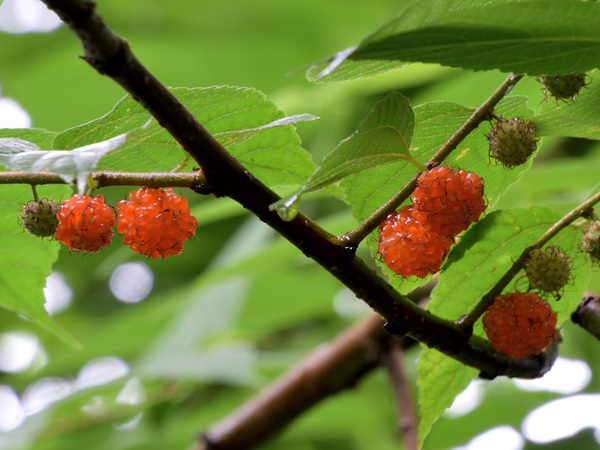
Broussonetia kazinoki ("Himekozo")
Japanese name: ヒメコウゾ
Scientific name: Broussonetia kazinoki
[Overview]
A deciduous shrub 2–5 m tall, found at forest edges in low mountains.
Young branches are rather densely covered with soft hairs.
The leaves are simple and alternate, distorted ovate, 4–10 cm long and 2–5 cm wide, and often deeply divided into 2–3 lobes.
The leaf tip is pointed like a tail.
The upper surface of the leaf has sparse short hairs and is rough, and the lower surface has soft hairs.
The leaf margins have many serrations.
The stipules are glandular-lanceolate, 3–8 mm long and 0.5–1 mm wide.
The petiole is 0.5–1 cm long.
There are male flowers and female flowers.
The inflorescences are borne one each in the leaf axils of young branches, with female inflorescences on the upper part of the branch and male inflorescences on the lower part.
The male inflorescence is spherical, about 1 cm across, and bears many small male flowers.
The stalk of the male inflorescence is 8–10 cm long and has soft hairs.
The male flower consists of 4 tepals and 4 stamens.
The female inflorescence is spherical, 0.4 cm across, and bears many small normal female flowers and sterile female flowers.
The female flower consists of 4 tepals and 1 pistil.
The fruit is an achene, but the stalk of the ovary and the perianth swell and enclose the fruit, forming a spherical aggregate fruit about 1.5 cm across overall, which ripens red.
[Uses]
The fibers are tough, and it was once used as a raw material for washi (Japanese paper).
Details
Translated from our Japanese encyclopedia. If anything differs, the Japanese page is correct.