
Plant Encyclopedia

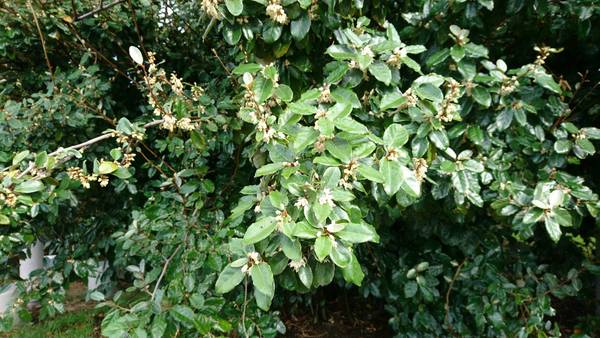
Elaeagnus pungens (thorny olive, "Nawashirogumi")
Japanese name: ナワシログミ (苗代茱萸、苗代胡頽子)
Scientific name: Elaeagnus pungens
[Overview]
An evergreen woody climber.
It branches freely.
There are thorns at the tips of twigs and in the leaf axils.
Young branches and petioles are densely covered with brown scales.
Leaves are simple and alternate, elliptic, 2–14 cm long and 1–6 cm wide, with a glossy upper surface.
The underside has dense dingy white to yellowish white scales and is not glossy.
The leaf margin is entire and wavy.
The petiole is 0.5–1.2 cm long.
Flowers are solitary in the axil of each bract on short branches arising from the leaf axils, and look like short racemes or clusters.
The flowers have no petals and are pale yellow, with a tubular calyx that is 4-lobed at the tip.
The fruit is an elliptic false fruit 1.5 cm long that ripens red, and hangs on a short stalk.
The surface of the fruit has brown scales.
[Uses]
The fruit is used medicinally.
[Cultivation]
Propagate by cuttings.
It prefers sunny, well-drained, fertile soil.
If the environment suits it, it grows well even when left alone.
For potted plants, water thoroughly when the soil surface dries; for plants in the ground, rainfall is sufficient unless summer brings a spell of sunny weather and the soil dries out.
Apply organic fertilizer around the plant as fertilizer in winter, and also place slow-release fertilizer on the soil in autumn.
There are no particular pests or diseases.
[Notes]
The Japanese name comes from the fruit ripening at the time of preparing the nawashiro, the seedbeds where rice seedlings are raised.
Details
Japanese: ナワシログミ(苗代茱萸、苗代胡頽子)
Translated from our Japanese encyclopedia. If anything differs, the Japanese page is correct.