
Plant Encyclopedia

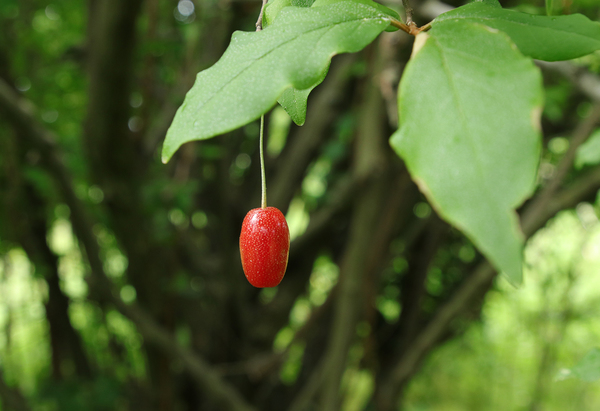
Elaeagnus multiflora var. gigantea ("Daiogumi")
Japanese name: ダイオウグミ (大王茱萸、大王胡頽子)
Scientific name: Elaeagnus multiflora var. gigantea
[Overview]
A small deciduous tree.
Young branches and leaf stalks are densely covered with pale brown scales.
The leaves are simple and alternate; those at the base of long and short shoots are small and become larger toward the branch tips.
The leaves are elliptic; the upper surface has no scales from the start and is densely covered only with stellate hairs that fall early.
The underside of the leaves is densely covered with silver scales, mixed with brown scales on the leaves at the base of the branches.
The leaf margins are entire.
The flowers are borne singly in the leaf axils, and there are male flowers and bisexual flowers.
The flowers have no petals and are pale yellow, with a tubular calyx that is 4-lobed at the tip.
The fruit is an elliptic false fruit about 2 cm long that ripens red and hangs down.
[Uses]
The fruit is sweet and edible, and is also used medicinally.
The roots and rhizomes are also used medicinally.
[Cultivation]
Propagate by cuttings.
It prefers sunny, well-drained, fertile soil.
Avoid places that become extremely dry.
For potted plants, water thoroughly when the soil surface dries; for plants in the ground, rainfall is sufficient unless summer brings a long spell of sunny weather and the soil dries out.
Apply organic fertilizer around the plant as fertilizer in winter, and also place slow-release chemical fertilizer on the soil in autumn.
There are no particular pests or diseases.
Details
Translated from our Japanese encyclopedia. If anything differs, the Japanese page is correct.