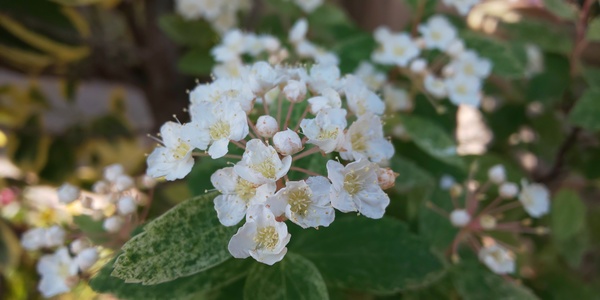
Japanese name: アイコデマリ(合小手毬、間小手毬) Scientific name:Spiraea ×vanhouttei
[Overview]
A deciduous shrub reaching about 1.5 m in both height and width.
The branches are slender, branching, and extend in an arch.
Leaves are simple and alternate, rhombic-elliptic to obovate, about 4 cm long and tinged with bluish green; the margin of the upper half has coarse serrations, and the leaf tip is often divided into 3–5 lobes.
The leaves turn red in autumn.
Hemispherical corymbs about 5 cm across at the tips of short branches densely bear white 5-petaled flowers about 0.7 cm across, and the flowers bloom so profusely that they cover the plant.
[History]
It arose from a cross between Yama-shimotsuke (Spiraea trilobata) and Kodemari (S. cantoniensis).
[Cultivation]
Propagate by division or by cuttings.
It prefers a sunny, well-drained soil.
For potted plants, water thoroughly when the soil surface dries; for plants in the ground, rainfall is sufficient unless summer brings a long spell of sunny weather and the soil becomes severely dry.
Apply organic fertilizer in winter, and after flowering place slow-release fertilizer on the soil as a thank-you fertilizer.
Flower buds form in autumn, so if pruning, do it as soon as possible after flowering.
Pests and diseases include powdery mildew and scale insects.