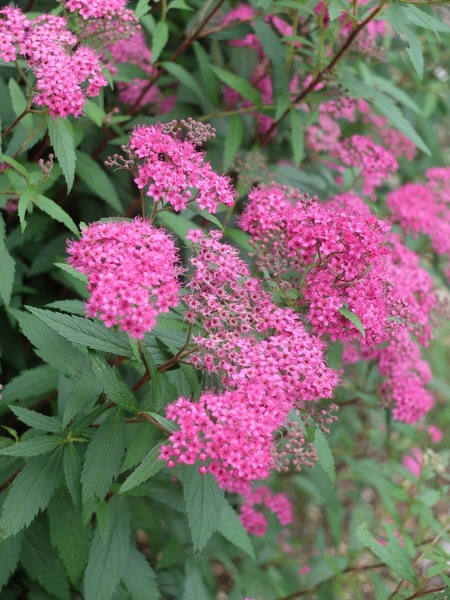
Spiraea japonica var. japonica(Japanese meadowsweet, "Shimotsuke")
Japanese name: シモツケ(下野) Scientific name:Spiraea japonica var. japonica
[Overview]
A deciduous shrub 0.5–1.5 m tall, found at sunny forest edges, in wetlands, and in grasslands in the mountains.
Young branches are reddish brown.
The leaves are simple and alternate, 3–9 cm long and 0.8–4 cm wide, elliptic to broadly ovate, with teeth on the margin.
Compound corymbs at the tips of the current year's branches bear many pale pink or white 5-petaled flowers 3–6 mm across.
The flowers have 23–30 stamens that protrude long.
The fruit is a follicle.
[Uses]
In China, the roots and leaves are used as a folk medicine.
[Cultivation]
Propagate from seed or by cuttings.
It prefers sunny, well-drained soil rich in humus.
For potted plants, water thoroughly when the soil surface dries; for plants in the ground, rainfall is sufficient unless summer brings a long spell of sunny weather and the soil becomes severely dry.
For potted plants, place slow-release fertilizer on the soil in spring; for plants in the ground, none is particularly necessary.
Pests and diseases include powdery mildew and scale insects.