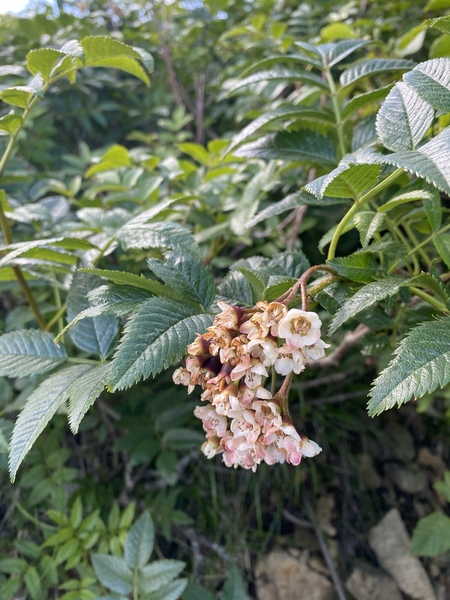
Sorbus sambucifolia var. sambucifolia("Takanenanakamado")
Japanese name: タカネナナカマド(高嶺七竈) Scientific name:Sorbus sambucifolia var. sambucifolia
[Overview]
A deciduous shrub 0.5–2 m tall, found in dry Japanese stone pine thickets from the subalpine to the alpine zone.
Young branches are sparsely covered with soft white hairs.
The leaves are alternate, odd-pinnately compound, 9–20 cm long, and consist of 7–11 leaflets.
The leaflets are narrowly ovate, 4–6 cm long and 1–2.5 cm wide, sharply pointed at the tip, with sharp serrations from the lower part.
The upper surface of the leaf is glossy with soft white hairs while young, and the underside is pale green.
The leaves turn a brilliant red in autumn.
The stipules are ovate-lanceolate, 0.4 cm long, and remain until flowering.
Compound corymbs 3–7 cm long at the branch tips bear several to a dozen or so flowers that bloom somewhat drooping.
The flowers are white tinged with pale red, 5-petaled, 0.7–1 cm across, with erect petals.
There are 5 styles.
The fruit is an elliptic pome 1.2–2 cm long, hanging down, ripening red, with erect sepals remaining at the top.