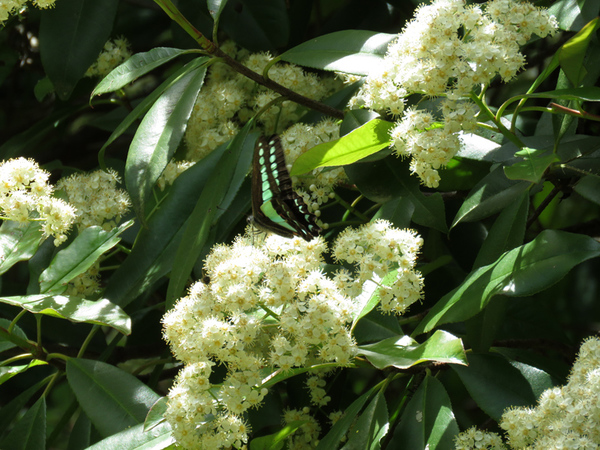
Japanese name: オオカナメモチ(大要黐) Scientific name:Photinia serratifolia
[Overview]
An evergreen tree 4–6 m tall, sometimes more than 10 m.
The leaves are simple and alternate, oblong to long obovate, 10–20 cm long and 4–8 cm wide.
There are 25–30 pairs of lateral veins.
The leaf margin is finely serrated except at the base.
The petiole is 2–4 cm long.
Compound corymbs at the branch tips bear many white flowers with 5 petals.
The flowers are 0.6–0.8 cm across, with many stamens.
The fruit is nearly spherical and ripens reddish purple.
[Uses]
The leaves are used medicinally.
[Cultivation]
Propagate from cuttings.
It prefers sunny, well-drained, fertile soil.
If sunlight is poor, the branches become sparse and the color of the new shoots is poor.
For established plants, rainfall is sufficient unless sunny weather continues in summer and the soil becomes severely dry.
Apply organic fertilizer in winter.
Prune in early summer, when the color of the new shoots has settled, and in September; however, flower buds form in summer, so if pruned in September, the plant will not flower the following year.
Pests and diseases include powdery mildew, brown spot, sesame-colored leaf spot, anthracnose, and borers (larvae of longhorn beetles).