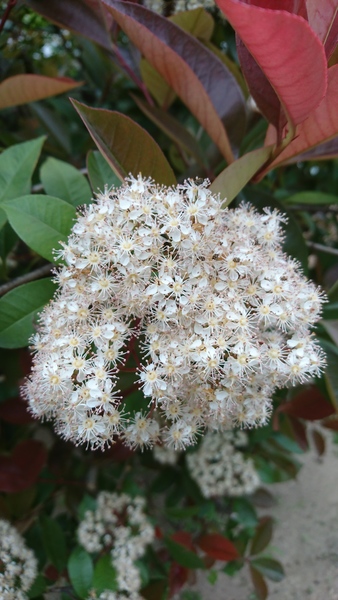
Japanese name: レッド ロビン Scientific name:Photinia ×fraseri ‘Red Robin’
[Overview]
A horticultural cultivar derived from a cross between Kanamemochi and Oo-kanamemochi.
Usually an evergreen shrub or small tree about 3–4 m tall.
Leaves are simple and alternate, oblong, 7–10 cm long and 3–5 cm wide, firm in texture, glossy on the upper surface, with fine teeth along the entire margin.
Young leaves are bright red and keep their color until the flowering season.
Corymbs at the branch tips bear many small white five-petaled flowers about 0.8 cm across.
There are many stamens.
[History]
It was bred in New Zealand.
[Cultivation]
Propagate by cuttings.
It prefers a sunny, well-drained, fertile soil.
In poor light, the branches become sparse and the color of the new shoots is poor.
For established plants, rainfall is sufficient unless summer brings a long spell of sunny weather and the soil becomes severely dry.
Apply organic fertilizer in winter.
Prune in early summer, when the color of the new shoots has settled, and in September; however, flower buds form in summer, so if pruned in September the plant will not flower the following year.
Pests and diseases include powdery mildew, brown spot, Cercospora leaf spot, anthracnose and teppo-mushi (longhorn beetle larvae).