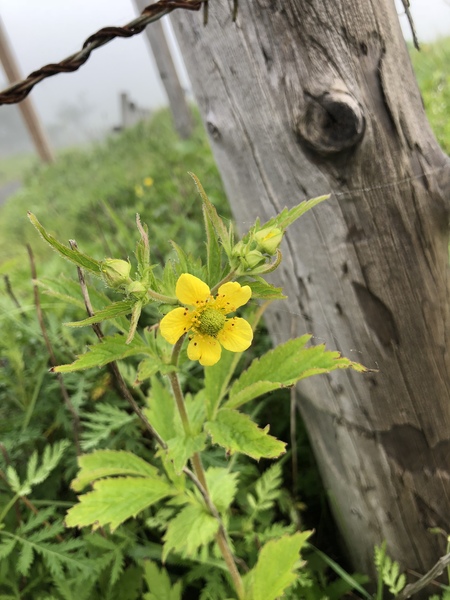
Japanese name: オオダイコンソウ(大大根草) Scientific name:Geum aleppicum
[Overview]
A perennial 40–100 cm tall, found in mountain grassland.
The whole plant is covered with stiff hairs.
The leaves are of two kinds, basal leaves and stem leaves; the basal leaves are odd-pinnately compound, about 12–30 cm long and 4–17 cm wide, with 2–5 pairs of lateral leaflets.
The terminal leaflet is 4–15 cm long and 3–17 cm wide, with irregular teeth on the margin.
The stem leaves are alternate and consist of 3–5 leaflets.
The stipules of the stem leaves are leaf-like, with irregular teeth on the margin.
A cyme at the stem tip bears 3–10 yellow 5-petaled flowers 1.2–2 cm across.
There are many stamens, and the receptacle is hemispherical.
The fruits are achenes, clustered in an elliptical mass.
The achenes retain hooked styles and are carried away by clinging to clothing and the like.
[Uses]
It is used medicinally.
[Cultivation]
Propagate from seed or by division.
A site that is sunny from autumn to spring and in partial shade with good ventilation in summer is suitable.
It prefers a well-drained site.
Water thoroughly when the soil surface dries.
Place slow-release fertilizer on the soil in spring and autumn, and do not leave any fertilizer in midsummer.
There are no particular pests or diseases.