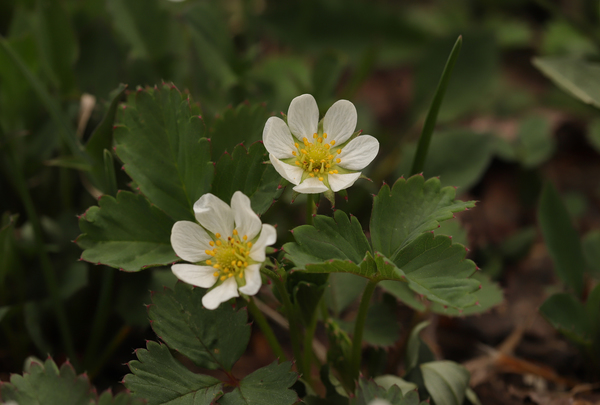
Japanese name: ノウゴウイチゴ(能郷苺) Scientific name:Fragaria iinumae
[Overview]
A perennial found in slightly moist grassland in the mountains.
It sends out runners, which root at the nodes and form daughter plants.
The rhizome is thick and short, retains old stipules, and becomes somewhat woody.
3–7 compound leaves, each made up of 3 leaflets, grow in a cluster from the tip of the rhizome.
The leaflets have coarse teeth, and the terminal leaflet is broadly obovate, 1.5–3 cm long and 1.2–2.5 cm wide.
The upper surface of the leaf is hairless, and the underside is tinged with a powdery white and bears long hairs on the veins.
The petiole is 2–8 cm long and hairy.
The stem bears simple leaves.
A cyme bears 1–4 flowers.
The flowers are white with 7–8 petals, 1.5–2.5 cm across, and the petals are oblong.
The stamens are 0.2 cm long, shorter than the sepals, and number 28–32.
The flower stalks bear long hairs.
The fruit is ovate, 0.8 cm across, ripens red, and is edible.
The part that looks like the fruit is the enlarged receptacle; the so-called strawberry "seeds" set in the pits on the receptacle surface are the true fruits (achenes).
[Notes]
The Japanese name derives from its being recorded in the Edo-period Somoku Zusetsu as growing on Nogohakusan, which straddles Fukui and Gifu.