EVERGREEN

Plant Encyclopedia

Fragaria ananassa

Fragaria ananassa (garden strawberry, "Orandaichigo")

Japanese name: オランダイチゴ (阿蘭陀苺)
Scientific name: Fragaria ananassa

Fragaria ananassa

[Overview]
A perennial created by hybridization.
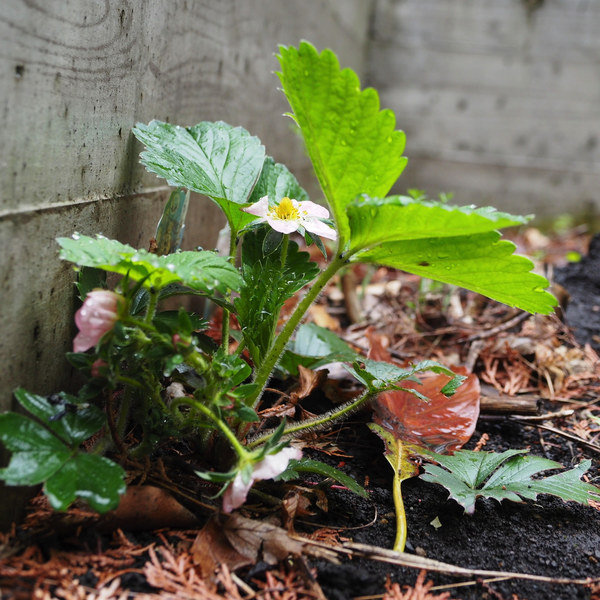
The whole plant is hairy.
It sends out runners from the leaf axils and bears young plants at their tips.
The leaves are basal or alternate, long-stalked, compound with 3 leaflets, and serrate.
The flowers are white with 5–8 petals.
The part that looks like the fruit is the enlarged receptacle, and the so-called ichigo grains set in the pits on its surface are the true fruits.

[History]
The name ichigo appears in The Pillow Book, but this does not refer to Oranda-ichigo.
It was brought to Japan by the Dutch in the 1800s.
Full-scale cultivation began in the period of high economic growth from the late 1960s.

[Uses]
It is sold in shops as ichigo.

[Cultivation]
Propagate by dividing the young plants.
Pests and diseases include virus disease, gray mold, cutworms, and aphids.
Also take care against damage to the fruit by slugs, pill bugs, and wild birds.

Details

Names
English: garden strawberry, strawberry, commercial strawberries
Japanese: オランダイチゴ(阿蘭陀苺)、イチゴ(苺)
Life form
Perennial
Habit
Terrestrial
Planting (or sowing) season
October, November
Flowering season
April, May
Fruiting season
May, June
Leaf shape
Trifoliate compound leaf
Leaf arrangement
Alternate
Leaf margin
Serrate
Flower color
White
Fruit color
Red, White
Leaf color
Green
Availability of seeds and plants
Low
Form sold
Seedlings
Propagation
Division
Sun exposure
Full sun
Soil needs
Required
Suitable uses
Ground cover, Potted plant, Flower bed, Parks and gardens, Container, Balcony, Hanging basket
Diseases
Viral disease, Gray mold, Powdery mildew, Anthracnose
Pests
Armyworms, Aphids, Slugs, Pill bugs, Cutworms, Spider mites, Whiteflies
Edible parts
Fruit
Uses
Edible
Japan Flower Trade Code
22374

Translated from our Japanese encyclopedia. If anything differs, the Japanese page is correct.

Sponsored