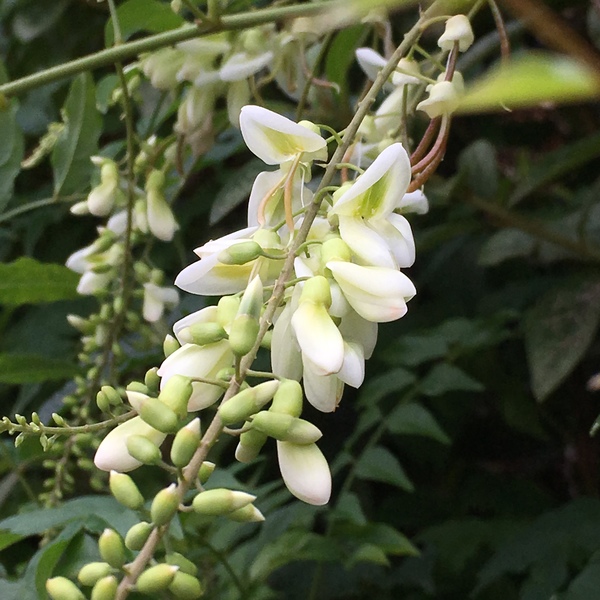
Japanese name: ナツフジ(夏藤) Scientific name:Wisteria japonica
[Overview]
A climbing deciduous shrub found in low mountain woods.
The vine twines to the left (counterclockwise when seen from above) and climbs by winding around other objects.
Young branches are at first covered with appressed hairs.
The leaves are alternate and odd-pinnately compound, 10–25 cm long, with 9–17 leaflets.
The leaflets are ovate, 2–6 cm long and 0.8–2 cm wide, almost hairless on both sides, with entire margins.
The stipules are needle-shaped.
Racemes 10–20 cm long arise from the leaf axils at the branch tips and bear many flowers.
The flowers are greenish-white pea-shaped flowers.
White hairs grow on the inflorescence, pedicels and other parts.
The fruit is a flat pod 10–15 cm long with a hairless surface.
The seeds are flat and round, about 0.7–0.8 cm across.
[Cultivation]
Propagate by cuttings or grafting.
It prefers a site with sun, good air circulation and good drainage.
Rainfall is sufficient unless summer brings a long spell of sunny weather and the soil dries out.
Rainfall is sufficient.
Apply fertilizer in winter and additional fertilizer after flowering, but too much nitrogen reduces flowering.
There are no particular pests or diseases.