
Plant Encyclopedia

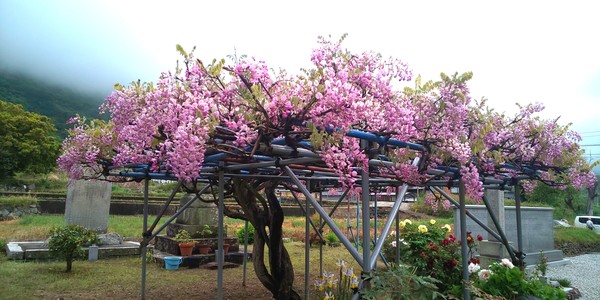
Wisteria brachybotrys (silky wisteria, "Yamafuji")
Japanese name: ヤマフジ (山藤)
Scientific name: Wisteria brachybotrys
[Overview]
A climbing deciduous woody plant growing to about 15 m long.
It is found at forest edges and in bright woods in low mountains of western Japan.
The vine twines to the left (counterclockwise when seen from above) and climbs by winding around other objects.
The leaves are alternate and odd-pinnately compound, 15–25 cm long, with 9–13 leaflets.
The leaflets are narrowly ovate, 4–7 cm long and 1.5–3 cm wide, with entire margins and dense short brown hairs on the underside.
The stipules are linear, about 8 mm long, and fall early.
The stipels are needle-shaped, 1.5–2.5 mm long.
Drooping racemes 10–20 cm long arise from the leaf axils at the branch tips and bear many flowers.
The flowers are pale purple or white pea-shaped flowers that face sideways, and they open almost all at once from the base of the raceme to the tip.
The fruit is a flat pod 15–20 cm long, densely covered with short hairs.
The seeds are flat and round, about 13 mm across, and glossy blackish purple.
[History]
It appears in the Kojiki, and 26 poems about Fuji are included in the Man'yoshu.
It has also long been used as a pattern and design motif, and as a family crest.
[Uses]
In the past, clothing was made from its fibers.
The young leaves, vines and flowers are used as wild vegetables.
The vines are used as craft material for chairs, baskets and the like.
The seeds are used as a folk medicine.
[Cultivation]
Propagate by cuttings or grafting.
Plants grown from seed take several decades to flower.
It prefers a sunny site with slightly heavy, moist soil.
It dislikes dryness.
When planted in the ground in a suitable place, no particular watering is needed.
For potted plants, water thoroughly when the soil surface dries.
Apply fertilizer in winter and additional fertilizer after flowering, but too much nitrogen reduces flowering.
Even old trees can be transplanted if dug up carefully without cutting the thick roots.
Pests and diseases include crown gall, leaf spot, rust, gall disease, Fuji-no-kikuimushi, leaf beetles and scarab beetles.
Details
Japanese: ヤマフジ(山藤)、カピタン(花美短)、ムラサキカピタン(紫花美短)、ダルマフジ
Translated from our Japanese encyclopedia. If anything differs, the Japanese page is correct.