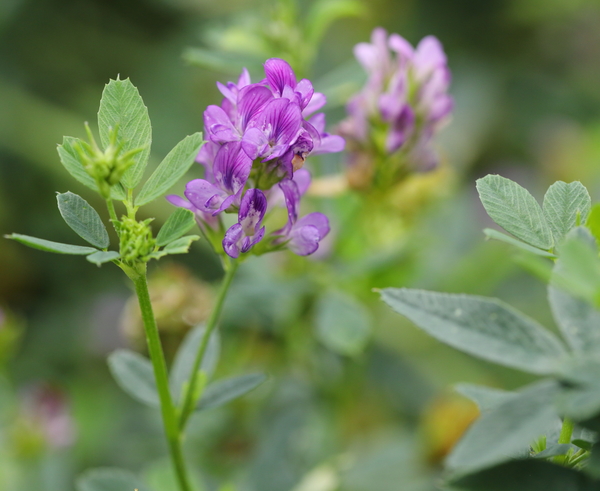
Japanese name: ムラサキウマゴヤシ(紫馬肥) Scientific name:Medicago sativa subsp. sativa
[Overview]
A perennial 0.3–1 m tall, found along roadsides and in grasslands.
The roots extend deep into the ground.
The stem is erect or rises obliquely, and is slightly soft-haired or hairless.
The leaves are alternate and odd-pinnately compound with 3 leaflets.
The leaflets are narrowly obovate to narrowly oblong, 2–3 cm long, with teeth on the upper half.
The stipules are triangular and either entire or toothed only at the base.
A raceme densely bears 10–20 flowers.
The flowers are purple to bluish purple papilionaceous flowers about 1 cm long.
The fruit is a flattened legume without spines, soft-haired or hairless, coiled spirally 1–3 times.
Each fruit contains 4–9 seeds.
[History]
It was introduced as a forage grass in the early Meiji era and has become naturalized.
[Uses]
It is used as a fodder crop.
The sprouts (moyashi) are eaten.