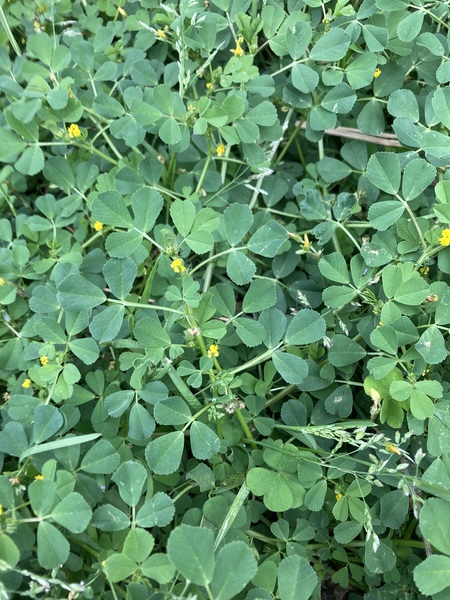
Medicago polymorpha var. polymorpha(California burclover, "Umagoyashi")
Japanese name: ウマゴヤシ(馬肥) Scientific name:Medicago polymorpha var. polymorpha
[Overview]
An annual or winter annual 0.1–0.6 m tall, found along roadsides and on seashores.
The whole plant is almost hairless.
The stem branches and either creeps along the ground or rises obliquely.
The leaves are alternate and odd-pinnately compound with 3 leaflets.
The leaflets are broadly obovate, 1–2 cm long, with teeth on the upper half and a rounded or slightly notched tip.
The stipules are deeply divided like the teeth of a comb.
A raceme bears 4–8 densely arranged flowers.
The flowers are yellow pea-shaped flowers about 0.3–0.5 cm long.
The fruit is a flat pod with hard hooked spines, either softly hairy or hairless, coiled spirally 2–3 times.
Each fruit contains about 5 seeds.
[History]
It was introduced as a forage grass in the Edo period and has become naturalized.
[Uses]
It is used as green manure and as a forage crop.
[Notes]
The name comes from its use as a forage grass.