
Plant Encyclopedia

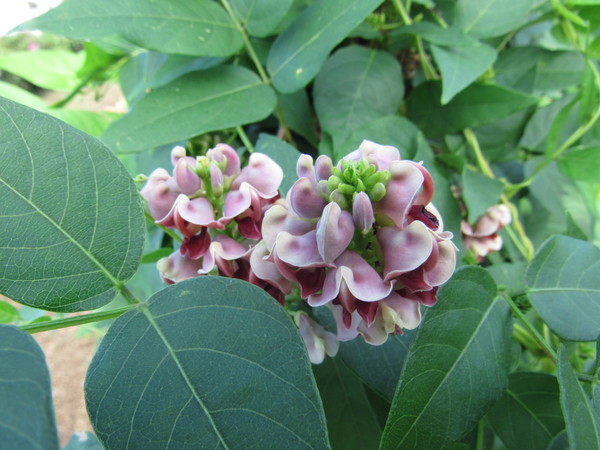
Apios americana (potato bean)
Japanese name: アメリカホド
Scientific name: Apios americana
[Overview]
A climbing perennial.
It has slender underground stems that bear tubers here and there.
The stem twines around other plants and grows to about 3 m long.
The leaves are alternate, odd-pinnately compound with 5–7 leaflets.
The leaflets are ovate to lanceolate with pointed tips.
The stipules are small and needle-like.
An erect pseudoraceme arises from the leaf axils and densely bears 10–40 flowers.
The flowers are pea-shaped, yellowish white to pale pink on the outside and purplish brown on the inside.
The legume is slender and flat, and splits open when ripe.
[History]
It was introduced in the middle of the Meiji era.
[Uses]
The tubers are eaten.
[Cultivation]
Propagate from seed tubers.
Seed tubers are difficult to store, so in winter bury them in soil to keep them from sprouting.
It prefers fertile soil that is sunny and well drained.
For potted plants, water thoroughly when the soil surface dries; for plants in the ground, rainfall is sufficient unless the summer is dry.
If a base fertilizer is applied, no further fertilizing is particularly necessary.
When harvesting the tubers, wait until the leaves have fallen and dig out the small tubers without damaging the roots.
If the remaining tubers are left as they are, they will sprout the following year.
There are no particular pests or diseases.
Details
Japanese: アメリカホド、アメリカホドイモ、アピオス、ホド(塊)、ホドイモ(塊芋)
Translated from our Japanese encyclopedia. If anything differs, the Japanese page is correct.