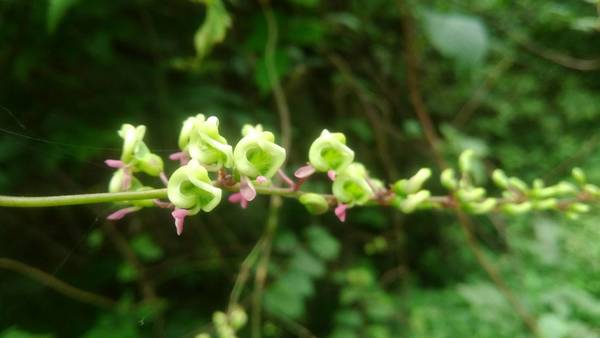
Japanese name: ホドイモ(塊芋) Scientific name:Apios fortunei
[Overview]
A climbing perennial found at sunny woodland edges.
It has slender underground stems that bear spindle-shaped to spherical tuberous roots here and there.
The stem twines around other plants and grows to more than 2 m long.
The leaves are alternate, odd-pinnately compound with 3–5 leaflets.
The terminal leaflet is ovate to broadly ovate, 5–12 cm long and 2–7 cm wide, with a somewhat long pointed tip and hairs on both surfaces.
The stipules are small, lanceolate to broadly linear.
A pseudoraceme arises from the leaf axils and bears flowers 2–4 at a time on nodes swollen into knobs.
The flowers are pale yellowish-green pea-shaped flowers; the wing petals are small with purple-tinged tips, and the keel petals curl inward.
The inflorescence continues to elongate during the flowering period.
The legume is slender and flat, 6–8 cm long, hairless, and splits open when ripe, releasing 5–6 adzuki-colored seeds.
[Uses]
The tuberous roots are small and few in number, but are edible.
They are also used medicinally.