
Plant Encyclopedia

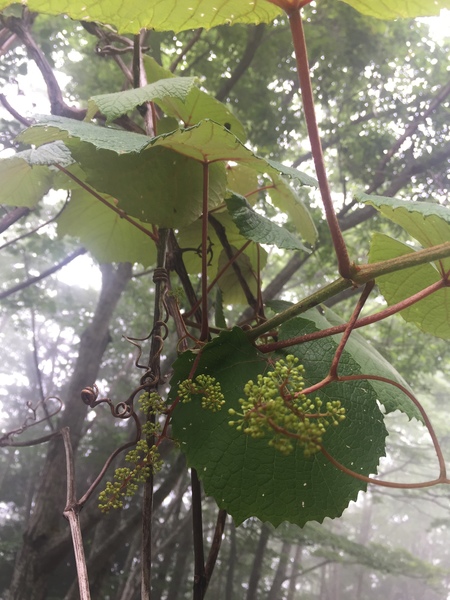
Vitis coignetiae (crimson glory vine, "Yamabudo")
Japanese name: ヤマブドウ (山葡萄)
Scientific name: Vitis coignetiae
[Overview]
A deciduous woody climber growing in the mountains.
Young branches are at first covered with cottony cobwebby hairs.
The leaves are alternate, 8–25 cm in both length and width, and 3–5-lobed.
The upper surface of the leaf is wrinkled, with depressions along the veins, and is at first covered with cobwebby hairs.
On the underside the veins are raised, and the surface is covered with cottony cobwebby hairs.
The cobwebby hairs on the underside of the leaf tend to wear off somewhat.
The leaf margin has irregular teeth.
The leaf stalk can reach 20 cm.
The leaves turn red in autumn.
Tendrils are produced opposite the leaves.
The plant is dioecious.
Conical cymes up to 20 cm long including the stalk are borne opposite the leaves.
The flowers are small and yellowish green; there are 5 petals, but they are joined at the top and fall off like a removed hat when the flower opens.
The fruit is a spherical fleshy berry about 0.8–1 cm in diameter, which ripens blackish purple and is edible.
[Uses]
The fruit is eaten raw and also made into jam, juice and the like.
The root bark is used as a folk medicine for external application.
The vines are used to weave baskets and the like.
Insects that burrow into the vines (budo-mushi) are used as fishing bait.
[Cultivation]
Propagate from seed or by cuttings.
Plants grown from seed turn out to be male or female.
It prefers sunny, airy, well-drained soil.
Rainfall is sufficient unless summer brings a long spell of sunny weather and the soil becomes severely dry.
Apply organic fertilizer around the plant as fertilizer in winter.
When pruning, cut back in winter, leaving the branches that grew the previous year.
There are no particular pests or diseases.
Details
Japanese: ヤマブドウ(山葡萄)
Translated from our Japanese encyclopedia. If anything differs, the Japanese page is correct.