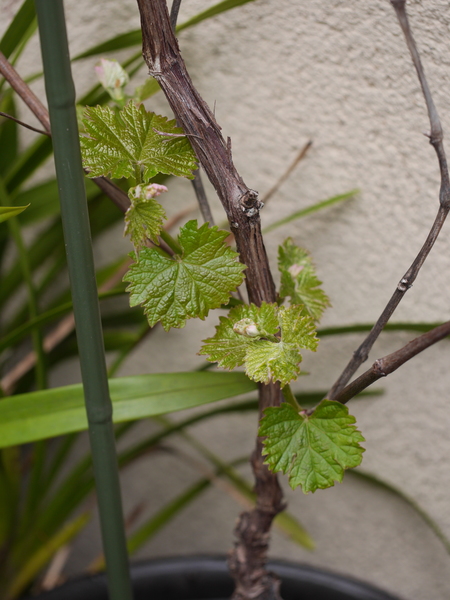
[Overview]
A deciduous climbing woody plant, of which about 60 species are known in the wild. It has tendrils and sometimes becomes shrub-like.
The leaves are simple and alternate, and many are palmately lobed.
Conical cymes arise opposite the leaves.
The flowers are small, bisexual or male depending on the plant, and have 5 petals that are fused at the top and fall off like a hat being removed when the flower opens.
There are 5 stamens, alternating with 5 nectaries.
The fruit is a spherical berry.
[History]
The plants mainly cultivated as fruit trees are said to be the European grape, the species of cultivated origin, the American grape, a cultivated species of North American origin, and hybrids of the two.
Cultivation of the European grape began in West Asia by 4,000 BC.
In Japan, a variety called 'Koshu' was discovered and began to be cultivated in the late Heian period, but full-scale cultivation began only in the Genroku era.
Modern grape cultivation began in the Meiji period and became fully established from the Taisho period onward.
[Uses]
The fruit is eaten fresh, processed into dried fruit, or fermented and used as a raw material for wine.