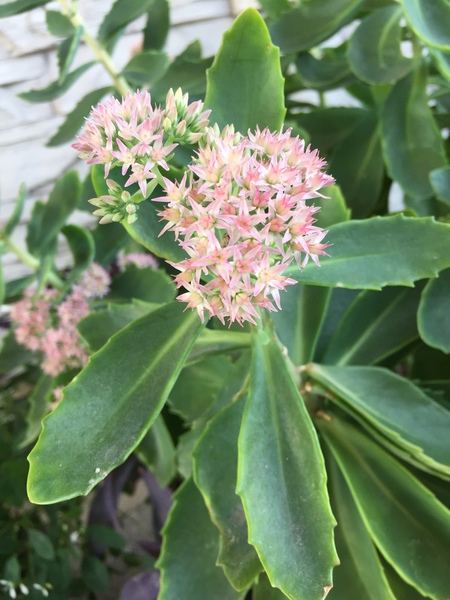
Japanese name: ベンケイソウ(弁慶草) Scientific name:Hylotelephium erythrostictum
[Overview]
An evergreen perennial 30–100 cm tall, growing in grasslands and sunny woodland.
It has a thickened underground rhizome.
The stems and leaves are pale yellowish green tinged with white, but are often densely marked with reddish purple spots.
The leaves are simple, alternate or opposite, elliptic-ovate to elliptic, 6–10 cm long and 2–4 cm wide, with margins that are not serrated or only have low serrations.
There are short petioles.
An upright flower stalk 30–100 cm tall bears a hemispherical corymb with densely packed flowers.
The flowers are small, red and 5-petaled, with petals 5–6 mm long.
There are 10 stamens, almost as long as the petals.
The anthers are dark reddish purple.
The fruit is a follicle, not much different in size from the ovary at flowering time.
[Cultivation]
Propagate by division, stem cuttings or leaf cuttings.
It prefers sunny, well-drained soil and is easy to grow.
[Notes]
It is a succulent that does not wilt easily and roots readily when cuttings are inserted, a strong plant, and so it was given the name "Benkei".