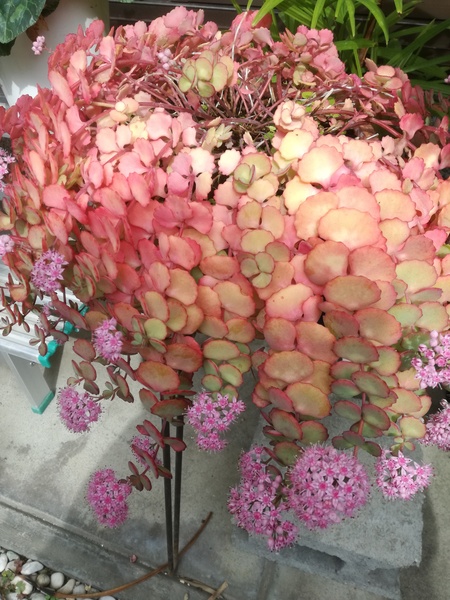
Hylotelephium sieboldii var. sieboldii("Misebaya")
Japanese name: ミセバヤ Scientific name:Hylotelephium sieboldii var. sieboldii
[Overview]
A perennial growing on rocks.
It has a rhizome.
The stems and leaves are fleshy.
The leaves are in whorls of 3, obovate to fan-shaped, 1–1.5 cm long and 1.3–2 cm wide, with a few wavy serrations.
The flower stalk hangs down and bears a spherical corymb at its tip.
The leaves and flower stalk are greenish white, as if dusted with powder.
Many flowers are densely clustered, each red with 5 petals.
[Cultivation]
Propagate from seed, by division or by stem cuttings.
It prefers sunny, airy, well-drained soil.
For potted plants, water when the soil dries, but hold back during the rainy season and the long autumn rains, since it may rot in excessive moisture.
For plants in the ground, rainfall is sufficient.
It is resistant to dryness.
If base fertilizer has been applied, no further fertilizing is particularly necessary.
Dead lower leaves left in place can cause disease, so remove them.
Pests and diseases include soft rot, aphids and slugs.
[Notes]
The Japanese name is said to come from "tare ni misebaya" (to whom shall I show it?), referring to its beautiful flowers.