
Plant Encyclopedia

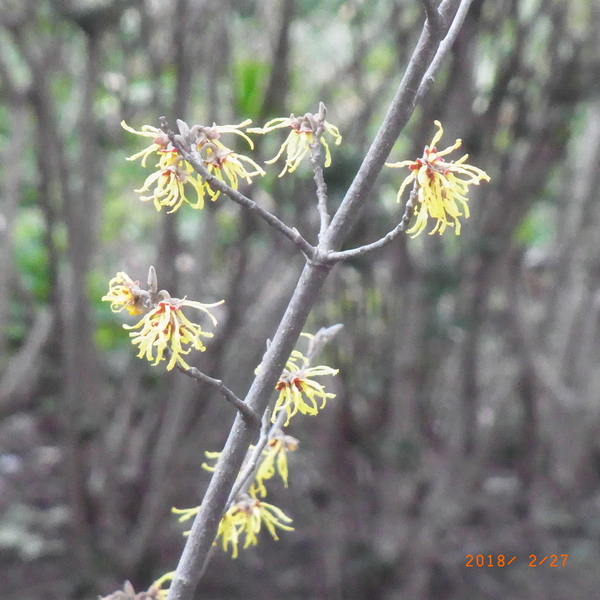
Hamamelis japonica var. japonica (Japanese witch hazel, "Mansaku")
Japanese name: マンサク (満作)
Scientific name: Hamamelis japonica var. japonica
[Overview]
A deciduous shrub to small tree 2–5 m tall, found on the Pacific side, sometimes exceeding 10 m.
Young branches and petioles have rather many stellate hairs.
The leaves are simple and alternate, rhombic-ovate to round, 5–10 cm long and 3.5–7 cm wide.
Stellate hairs grow on both surfaces of the leaves.
The leaf margin has rounded, wavy teeth.
The petiole is 0.5–1.5 cm.
The flowers open before the leaves unfold and grow in clusters of 2–4 in the leaf axils.
The flowers are yellow with 4 petals; the petals are narrow, ribbon-like, twisted, and 1–1.5 cm long.
There are 4 short stamens.
The fruit is a capsule 1–1.3 cm long and 0.8–0.9 cm wide, densely covered with pale brown stellate hairs.
[Cultivation]
Propagate by layering.
It prefers a sunny, well-drained, moisture-retentive, fertile soil.
It is not suited to places with strong afternoon sun or severe summer dryness, because it drops its leaves there.
For potted plants, water thoroughly when the soil surface dries.
For plants in the ground, rainfall is sufficient except when sunny summer weather continues and the soil dries out.
Apply organic fertilizer around the plant in winter; applying it in spring as well speeds growth.
Prune after flowering and before new shoots emerge, but since the natural tree form is often enjoyed, limit pruning to removing dead branches.
There are no particular pests or diseases.
[Notes]
There are several theories about the origin of the Japanese name, such as that it is a corruption of "mazu saku" ("blooms first"), since the plant flowers early in spring.
Details
Japanese: マンサク(満作)
Translated from our Japanese encyclopedia. If anything differs, the Japanese page is correct.