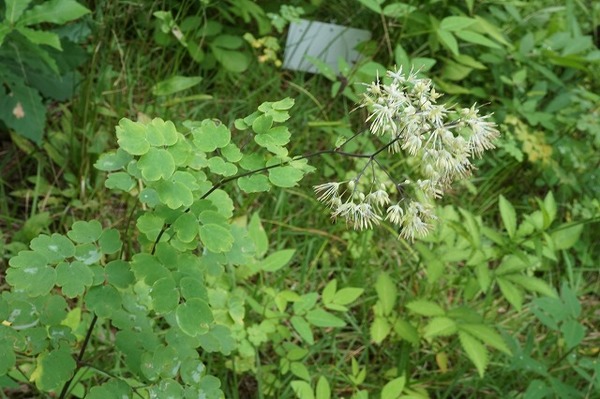
Japanese name: アキカラマツ(秋唐松) Scientific name:Thalictrum minus var. hypoleucum
[Overview]
A perennial of hills and fields that is extremely variable.
The stem branches in the upper part.
There are basal leaves and stem leaves; the basal leaves persist through the flowering period.
The stem leaves are alternate and 3–5 times ternately compound.
The leaflets are ovate to obovate, shallowly 3–5-lobed at the tip.
Stipules are attached at the base of the petiole and at the base of the leaflet stalks.
A large panicle at the stem tip bears many flowers.
The flowers are small and pale yellowish white; there are no petals, and the petal-like sepals also fall early after flowering.
The many stamens are conspicuous.
The fruit is an achene.
[Uses]
It is poisonous, but is used as a folk remedy.
[Cultivation]
Propagate from seed or by division.
It prefers fertile soil that is well drained and retains water well.
Give it sun from autumn to spring, and keep it cool in partial shade in summer.
When planting in the ground, plant it under deciduous trees.
Take care that it does not dry out; from spring to autumn, water thoroughly when the soil surface dries, and in winter avoid letting it become extremely dry.
Apply basal fertilizer, and also place slow-release fertilizer on the soil in spring and autumn, making sure no fertilizer remains in midsummer.
Pests and diseases include soft rot, powdery mildew, spider mites and aphids.