
Plant Encyclopedia

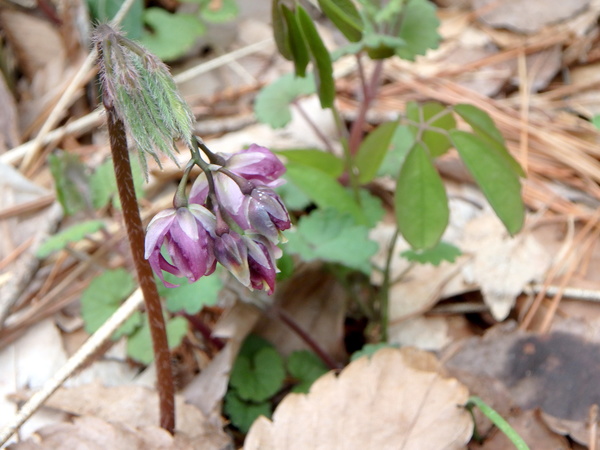
Epimedium grandiflorum (large flowered barrenwort)
Japanese name: イカリソウ(広義) (碇草、錨草)
Scientific name: Epimedium grandiflorum
[Overview]
A perennial 20–40 cm tall, found mainly on the Pacific side in deciduous forests and at forest edges.
The leaves are 1–3 times ternately compound.
The leaflets are ovate, 3–10 cm long and 2–6 cm wide, with a deeply heart-shaped base and a tip that gradually narrows.
Spiny hairs grow on the leaf margins.
Young leaves have brown hairs along with the leaf stalks.
A raceme emerges at the stem tip and bears four-petaled flowers that are reddish purple, pale purple or white.
There are 8 sepals; the inner 4 are large and petal-like, and the outer 4 are small and fall early.
The base of each petal has a spur 1.5–2 cm long.
The fruit is a follicle.
[Uses]
It is used medicinally.
[Cultivation]
Propagate from seed or by division.
From winter through the flowering period, keep it in a sunny place; in summer, keep it in a cool place with bright shade.
Also protect it from cold winter winds.
For plants in the ground, under deciduous trees is good.
It prefers fertile, well-drained soil.
For potted plants, water thoroughly when the soil surface dries; for plants in the ground, rainfall is sufficient unless summer brings a long spell of sunny weather and the soil becomes severely dry.
If base fertilizer is applied, no further fertilizer is particularly necessary, but for potted plants diluted liquid fertilizer may be given in spring and autumn.
There are no particular pests or diseases.
Details
Japanese: イカリソウ(広義)(碇草、錨草)
Translated from our Japanese encyclopedia. If anything differs, the Japanese page is correct.