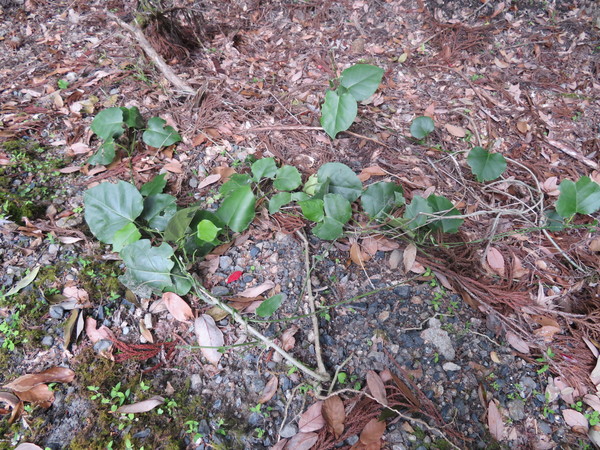
Japanese name: ツヅラフジ(葛藤) Scientific name:Sinomenium acutum var. acutum
[Overview]
A deciduous woody vine found at forest edges and similar places.
The vine twists to the left; when thick it reaches 3 cm in diameter, and it grows to about 10 m.
Young branches are green and smooth, slightly hairy, but become hairless later.
Stolons also creep along the ground.
The leaves are alternate, ovate-circular to circular, 6–15 cm long and 5–13 cm wide, and vary from polygonally 5–7-lobed to unlobed.
The upper surface of the leaf is hairless; the underside is powdery white and slightly hairy when young; the margin is entire.
The petiole is 5–10 cm long and is not attached peltately.
It is usually dioecious, but may also be monoecious.
Both male and female flowers are borne in large numbers in panicles about 15 cm long from the branch tips or leaf axils; they are small, pale green, 6-petaled flowers about 0.4 cm across.
Male flowers have 9–12 stamens, and female flowers have 3–9 staminodes and 3 pistils.
The fruit is spherical, 0.6–0.7 cm in diameter, borne in sparse clusters, and ripens blue-black with a powdery white bloom.
The fruit is poisonous.
The seeds are somewhat flattened, with raised, uneven margins, giving them a distinctive shape.
[Uses]
The stems and rhizomes are used medicinally.
The vines are used to weave baskets and similar items.
[Notes]
The Japanese name comes from the vines being woven into tsuzura (wicker baskets).