
Plant Encyclopedia

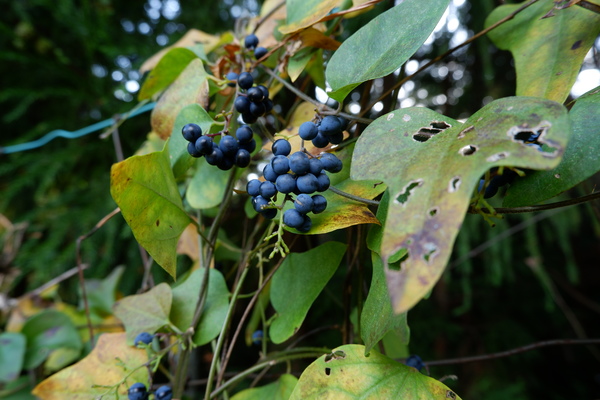
Cocculus trilobus ("Aotsuzurafuji")
Japanese name: アオツヅラフジ (青葛藤)
Scientific name: Cocculus trilobus
[Overview]
A deciduous woody climber found at forest edges, in grasslands and along roadsides.
The vine twines to the left and grows up to about 5 m.
The stems branch frequently.
First-year stems are green and densely covered with gray hairs.
The leaves are alternate, ovate, 3–12 cm long and 2–10 cm wide, or shallowly 3-lobed on leaves borne on vigorous shoots.
The leaves are hairy and the margins are entire.
It is dioecious.
Both male and female flowers are borne densely in panicles arising from the leaf axils, and are cream to yellowish green with 6 petals.
The fruit is spherical, 7 mm in diameter, borne in clusters like bunches of grapes; it ripens to indigo-black and is covered with a white bloom.
The seeds are shaped like ammonite fossils.
[Uses]
The stems and roots are used medicinally.
[Cultivation]
Propagate from seed, by division, or by root cuttings.
It prefers a well-ventilated site in sun to partial shade.
It prefers fertile, slightly moist soil with good drainage and aeration.
Avoid strong summer sun and afternoon sun from the west.
In winter, place it where it is not exposed to cold wind, and keep the soil from freezing.
It is sensitive to drying out, so water thoroughly as soon as the surface of the soil in the pot begins to dry.
In summer especially, the leaves wilt easily, so water in the morning and evening when temperatures are lower.
From spring to autumn, apply slow-release fertilizer around the plant about once a month.
Because it is dioecious, if you want to enjoy the fruit, prepare both female and male plants and pollinate by hand.
Pests and diseases include spider mites and aphids.
Details
Translated from our Japanese encyclopedia. If anything differs, the Japanese page is correct.