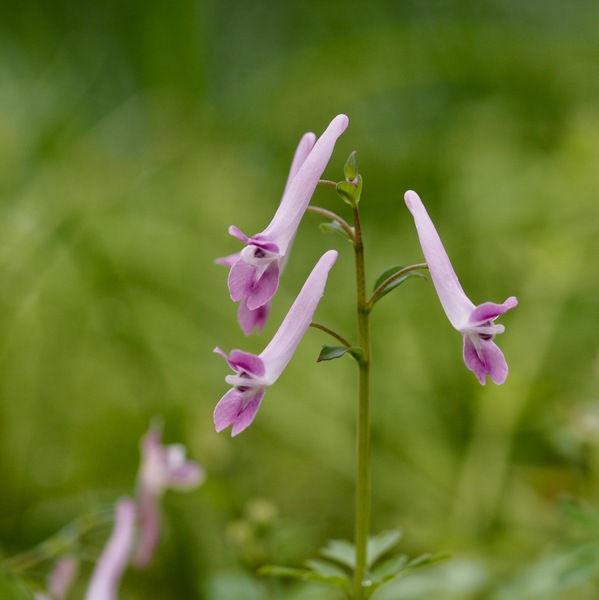
Japanese name: ジロボウエンゴサク(次郎坊延胡索) Scientific name:Corydalis decumbens
[Overview]
A perennial 5–20 cm tall, growing in slightly moist forest edges and grasslands on riverbanks.
The plant is soft and powdery white all over.
It has a round tuber underground, and each year a new tuber forms directly above the old one.
Several flower stems and basal leaves arise from the tuber.
The basal leaves are 2–3 times ternately compound, and the leaflets are deeply cut 2–3 times.
The flower stem bears two stalked leaves.
A raceme at the stem tip bears sparse flowers.
The flowers are 12–22 mm long, pale reddish purple to bluish purple, rarely white.
There are 4 petals, but the upper one is longer than the others and has a long spur.
The fruit is a capsule 15–22 mm long.
The seeds have an appendage (caruncle) that ants like, and they are carried and dispersed by ants.
[Uses]
The whole plant contains toxic components, and the tuber is used medicinally.
[Notes]
The Japanese name "Jirobo" is said to derive from a game in the Ise region of Mie, where the violet is called Tarobo and this species Jirobo, and the spurs of the respective flowers are hooked together and pulled against each other.