
Plant Encyclopedia

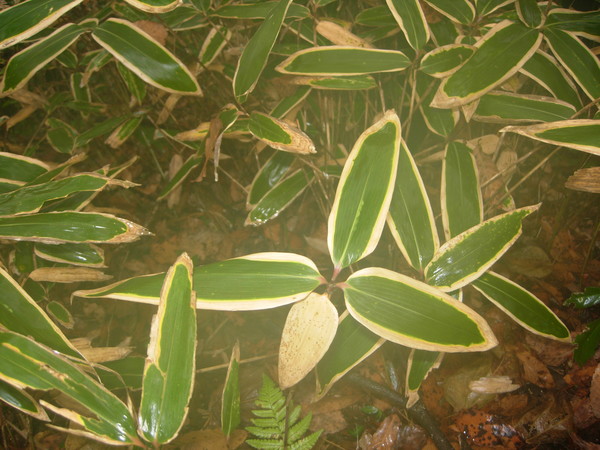
Sasa veitchii var. veitchii ("Kumazasa")
Japanese name: クマザサ (隈笹)
Scientific name: Sasa veitchii var. veitchii
[Overview]
A bamboo grass 0.5–2 m tall.
The rhizomes creep for long distances, and it grows in colonies.
The culms (stems) branch sparsely at the base and are 0.3–0.8 cm in diameter; they are usually hairless, as are the nodes and leaves, and are wrapped in bamboo sheaths.
One branch emerges at each node, bearing 2–7 leaves at its tip.
The leaves are oblong, about 20–25 cm long and 4–5 cm wide, hairless on both surfaces and somewhat thick; in winter the margins are edged in white.
The shoulder bristles are well developed and radiate outward.
The bamboo sheaths have spreading hairs.
The conical inflorescence bears spikelets, each consisting of 4–8 florets.
[Uses]
The leaves are used to wrap food and as a raw material for aojiru (green juice), and are also drunk as tea.
It is also used medicinally.
[Cultivation]
Propagate by division.
It can be planted at any time of year, but spring and autumn are best.
It prefers a place in sun to partial shade with good drainage and good water retention.
The leaves may scorch in the afternoon sun or strong direct summer sunlight, so bright shade such as under deciduous trees gives better leaf color.
If it runs short of water, the leaves may curl or wither, and it also dislikes drying of the rhizomes, so it is best to avoid places that become very dry.
It is hardy and spreads by extending its rhizomes, so to keep it from spreading too much it is better to set a barrier frame underground.
To keep the plant height low, cut it back in February–March.
Rainfall is sufficient for watering.
Fertilizer is not particularly necessary.
There are no particular pests or diseases.
[Notes]
The name comes from the white-edged leaf margins in winter.
Details
Translated from our Japanese encyclopedia. If anything differs, the Japanese page is correct.