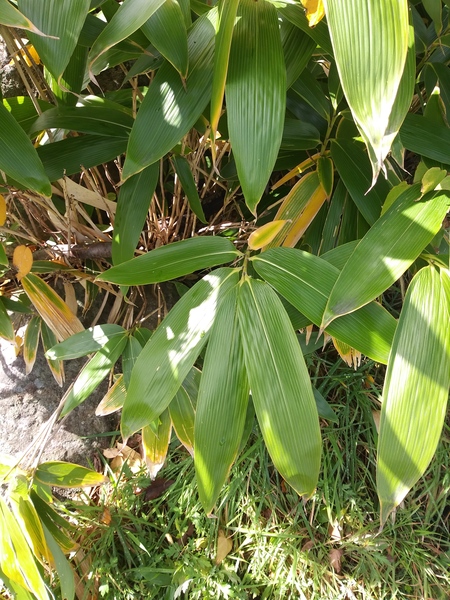
Japanese name: スズタケ Scientific name:Sasa borealis var. borealis
[Overview]
A bamboo grass 1–3 m tall, found mainly in beech forests and similar places in the mountains on the Pacific side.
The rhizomes creep for long distances, and it often grows in colonies.
The culms (stems) stand erect from the base and are 0.5–0.8 cm in diameter; the nodes are not swollen, and the unbranched part is wrapped in bamboo sheaths.
At the upper part of the culm, one branch emerges at each node, bearing 2–3 leaves at its tip.
The leaves are oblong-lanceolate, 10–30 cm long and 1–6 cm wide, thick, hairless on both surfaces, smooth and glossy on the upper surface, and slightly whitish and powdery on the underside.
The bamboo sheaths usually have sparse stiff hairs.
The conical inflorescence bears spikelets, each consisting of 5–8 florets.
[Uses]
The bamboo shoots are edible, and the culms are used for fishing rods and similar items.
[Notes]
One theory holds that the name comes from comparing the sound of the leaves rustling in the wind to the sound of a bell.