EVERGREEN

Plant Encyclopedia

Briza media

Briza media (quaking grass, "Chukobanso")

Japanese name: チュウコバンソウ (中小判草)
Scientific name: Briza media

Briza media

[Overview]
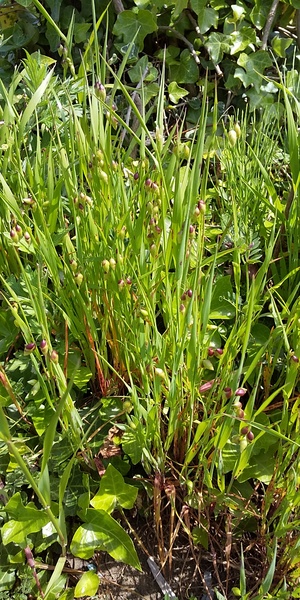
A perennial 40–90 cm tall, rarely found in sunny places such as fields and roadsides.
It has a short, creeping rhizome.
The stem is erect, and dead leaf sheaths overlap at the base.
It produces non-flowering stems bearing only basal leaves around the base of the stem.
The leaves are linear.
A paniculate inflorescence with a drooping tip emerges at the top of the stem, and several spikelets hang down.
The spikelets are oval with a pointed tip, about 0.5 cm long, thick, tinged with reddish purple, and glossy.
Each spikelet consists of several to about 10 florets.

[History]
It arrived in Japan in the early Meiji period and has rarely become naturalized.

[Cultivation]
Propagate from seed.
It grows well in any soil as long as the site is sunny.
Cultivation is easy.
There are no particular pests or diseases.

Details

Names
English: quaking grass, cow-quake, didder, dithering-grass, dodder-grass, doddering dillies, doddle-grass, earthquakes, jiggle-joggles, jockey-grass, lady's-hair, maidenhair-grass, pearl grass, quakers, quakers-and-shakers, shaking-grass, tottergrass, wag-wantons
Japanese: チュウコバンソウ(中小判草)、シュッコンコバンソウ(宿根小判草)
Life form
Perennial
Habit
Terrestrial
Planting (or sowing) season
September, October
Flowering season
May, June
Distribution or origin
Europe
Height
400–900 mm
Leaf shape
Linear
Inflorescence
Spikelet
Leaf color
Green
Availability of seeds and plants
Low
Form sold
Seeds
Propagation
Seed
Sun exposure
Full sun
Water needs
Moderate
Soil needs
Required
Suitable uses
Cut flowers
Hardiness zone
4a–11b
Japan Flower Trade Code
123492

Translated from our Japanese encyclopedia. If anything differs, the Japanese page is correct.

Sponsored