EVERGREEN

Plant Encyclopedia

Briza maxima

Briza maxima (big quaking grass, "Kobanso")

Japanese name: コバンソウ (小判草)
Scientific name: Briza maxima

Briza maxima

[Overview]
An annual 30–60 cm tall, found in sunny places such as fields and roadsides.
The stem is erect.
The leaves are linear, 5–10 cm long and 0.3–0.8 cm wide, with rough margins.
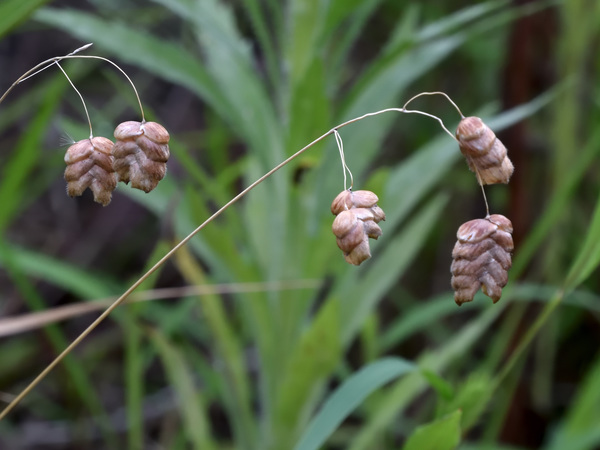
A paniculate inflorescence with a drooping tip emerges at the top of the stem, and 5–15 spikelets hang down.
The spikelets are oval like an old oval gold coin (koban), 1–2 cm long and 1 cm wide, thick, pale green to yellowish brown, and glossy.
Each spikelet consists of about 10 florets.

[History]
It arrived in Japan in the Meiji period and has become naturalized in various places.

[Cultivation]
Propagate from seed.
It grows well in any soil as long as the site is sunny.
Cultivation is easy.
There are no particular pests or diseases.

[Notes]
The name compares the spikelets to koban (oval gold coins).

Details

Names
English: big quaking grass, great quaking grass, greater quaking-grass, large quaking grass, blowfly grass, rattlesnake grass, shelly grass, rattle grass, shell grass
Japanese: コバンソウ(小判草)、タワラムギ(俵麦)
Life form
Annual
Habit
Terrestrial
Planting (or sowing) season
September, October
Flowering season
July, August, September
Distribution or origin
Mediterranean coastal region
Height
300–600 mm
Leaf shape
Linear
Inflorescence
Spikelet
Leaf color
Green
Availability of seeds and plants
Low
Form sold
Seeds
Propagation
Seed
Sun exposure
Full sun
Water needs
Moderate
Soil needs
Required
Suitable uses
Cut flowers
Japan Flower Trade Code
19775

Translated from our Japanese encyclopedia. If anything differs, the Japanese page is correct.

Sponsored