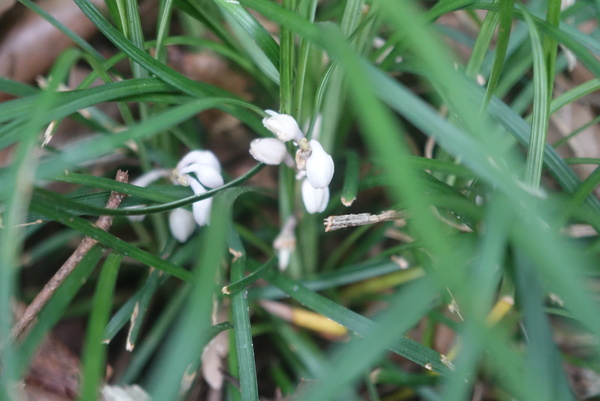
Ophiopogon japonicus var. japonicus(dwarf lilyturf, "Janohige")
Japanese name: ジャノヒゲ(蛇鬚) Scientific name:Ophiopogon japonicus var. japonicus
[Overview]
An evergreen perennial found in woodland.
It spreads by sending out creeping stems underground.
The roots have spindle-shaped swellings.
The leaves are basal and simple, linear, 10–40 cm long and 0.2–0.3 cm wide, with fine serrations on the upper margin.
A flower stalk 6–9 cm long rises and bears a raceme 1–9 cm long.
At each node of the inflorescence, 1–4 pale purple to white six-petaled flowers hang downward.
After flowering, the pericarp falls early, and the seeds mature exposed.
The seeds are spherical, 0.6–0.8 cm in diameter, and deep blue.
[Uses]
The swollen parts of the roots are used medicinally.
[Cultivation]
Propagate by division.
From sun to shade, it is not particular about soil, adapts to a wide range of environments, and grows easily and well.
For potted plants, water thoroughly when the soil surface dries; for plants in the ground, rainfall is sufficient.
Fertilizer is not particularly needed for plants in the ground; for potted plants, apply slow-release fertilizer twice, in spring and autumn.
There are no particular pests or diseases.