
Plant Encyclopedia

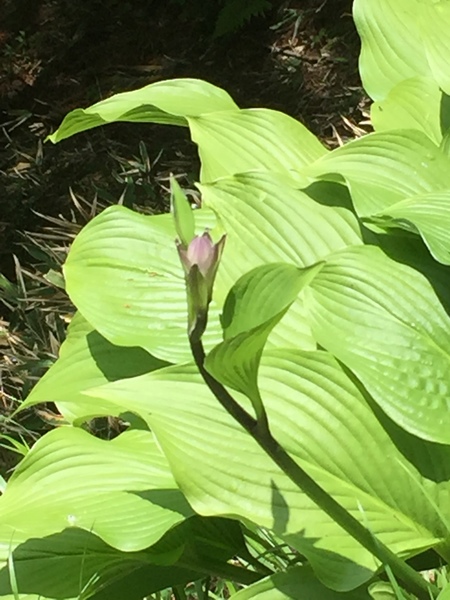
Hosta sieboldiana var. sieboldiana ("Togiboshi")
Japanese name: トウギボウシ (唐擬宝珠)
Scientific name: Hosta sieboldiana var. sieboldiana
[Overview]
A perennial found in mountain grasslands and at forest edges.
It has a rhizome.
The leaves are simple and basal, elliptic to ovate, 30–40 cm long, with the veins on the upper surface sunken.
The upper surface of the leaf is not glossy, and the margin is entire.
The leaf base does not run down the petiole.
A raceme at the tip of a flower stalk 50–100 cm tall bears many flowers.
There are large, thick, oblong bracts.
As the flower stalk begins to elongate, the bracts overlap and enclose the buds; they then unfold and, at flowering, open at right angles to the flower stalk.
The flowers are funnel-shaped, 6-petaled, 4–5 cm long, and white or pale purple.
The flowers open in the morning and wilt in the evening, lasting one day.
The fruit is a capsule, and the seeds are winged on one side.
[Uses]
The young leaves and buds are used as wild vegetables.
[Cultivation]
Propagate from seed or by division.
It prefers sun to bright shade and moderately moist soil that is well drained and retains water well.
Strong direct sunlight in summer can scorch the leaves, so move potted plants to airy shade in summer, and plant those in the ground under deciduous trees or similar.
For potted plants, water thoroughly when the soil surface dries; for plants in the ground, rainfall is sufficient unless summer brings a long spell of sunny weather and the soil dries out.
In spring and autumn, apply organic fertilizer placed on the soil.
Pests and diseases include southern blight, viral disease, aphids and slugs.
Details
Translated from our Japanese encyclopedia. If anything differs, the Japanese page is correct.