
Plant Encyclopedia

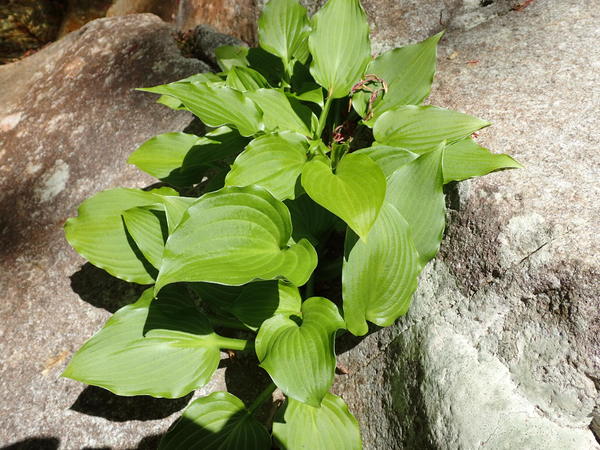
Hosta longipes var. longipes ("Iwagiboshi")
Japanese name: イワギボウシ (岩擬宝珠)
Scientific name: Hosta longipes var. longipes
[Overview]
A perennial growing on cliffs along mountain streams, on rocks, and on trees.
The leaves form a rosette, are ovate and 10–13 cm long, with a heart-shaped base, and are thick and glossy.
They have long leaf stalks.
A raceme arises at the tip of a flower stalk 25–30 cm long, with a bract at the base of each flower.
The bracts are 0.7–1.2 cm long, thin, and withered at flowering.
The corolla is bell-shaped, white to pale purple, with 6 tepals about 4 cm long.
Transparent lines are present only in the wide part of the tube.
The stamens protrude out of the flower.
Each flower opens in the morning and withers in the evening, lasting one day.
The fruit is a capsule.
[Cultivation]
Propagate from seed or by division.
It prefers bright shade and moderately moist soil that is well drained and retains water well.
Strong direct sun in summer can cause leaf scorch, so move potted plants to airy shade in summer, and plant those in the ground under deciduous trees or similar.
For potted plants, water thoroughly when the soil surface dries; for plants in the ground, rainfall is sufficient unless sunny weather continues in summer and the soil dries out.
In spring and autumn, apply organic fertilizer placed on the soil.
Pests and diseases include southern blight, viral disease, aphids and slugs.
Details
Translated from our Japanese encyclopedia. If anything differs, the Japanese page is correct.