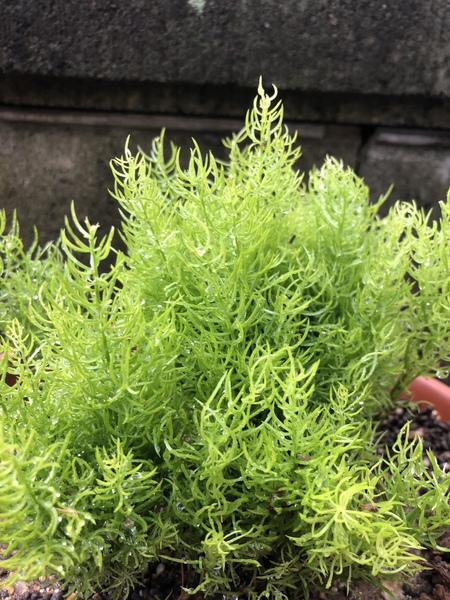
Japanese name: オランダキジカクシ(阿蘭陀雉隠) Scientific name:Asparagus officinalis
[Overview]
A dioecious perennial about 1.5 m tall with erect herbaceous stems.
It has a bulb underground.
The stem branches well and is round in cross section.
The stem has no spines.
The leaves are reduced to scales and pressed against the stem.
The cladodes (leaf-like branches) are thread-like, with many emerging in a tuft from one spot.
The flowers are greenish white and bell-shaped, borne 1–4 at a time in the leaf axils and hanging down.
There are 6 tepals.
The fruit is spherical, 6–9 mm across, and ripens to a bright red.
[Uses]
Young stems that have grown to about 20–30 cm are harvested and eaten.
Those grown by blanching are called white asparagus.
[Cultivation]
It prefers well-drained, well-aerated soil with a pH of 5.8–6.5, and has strong salt tolerance.
Plant it in a sunny place.
Propagate mainly from seed or by division.
[Notes]
There is also a view that treats the edible asparagus as a variety, Asparagus officinalis var. altilis.