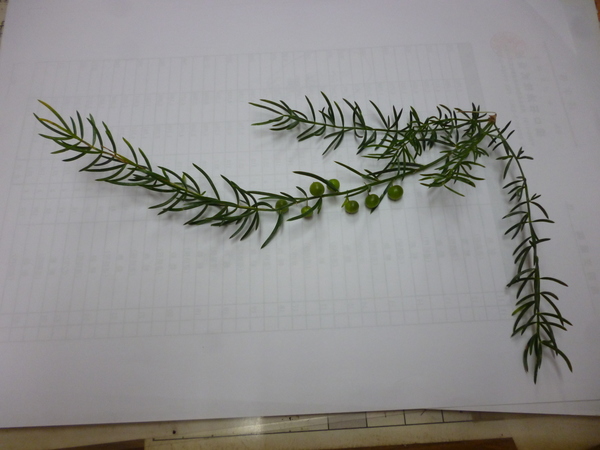
Japanese name: クサスギカズラ(草杉蔓) Scientific name:Asparagus cochinchinensis
[Overview]
A perennial found on rocky ground and sandy areas near the coast.
The roots swell into a spindle shape.
The stem is slender and ridged; the base is woody and erect, while the upper part stretches out like a vine and twines around other plants, reaching 1–2 m in height.
The thick branches have spines 0.3–0.5 cm long, which are modified leaves.
The leaves are reduced to scales and pressed against the stem.
The cladodes (leaf-like branches) grow in clusters of 2–3 at the leaf axils; they are slightly flattened and linear, 0.7–4 cm long, with 3 ridges, slightly curved, pointed and glossy, and shaped like the leaves of the sugi (Japanese cedar).
It is dioecious.
The flowers are yellowish white and bell-funnel-shaped, borne 2–3 at a time in the leaf axils, with a flower stalk 0.2–0.5 cm long that has a joint in the middle.
There are 6 tepals.
The fruit is spherical, 0.6–0.7 cm across, and ripens to a dull white.
[Uses]
The swollen, spindle-shaped roots are called tenmondo and are used medicinally.