
Plant Encyclopedia

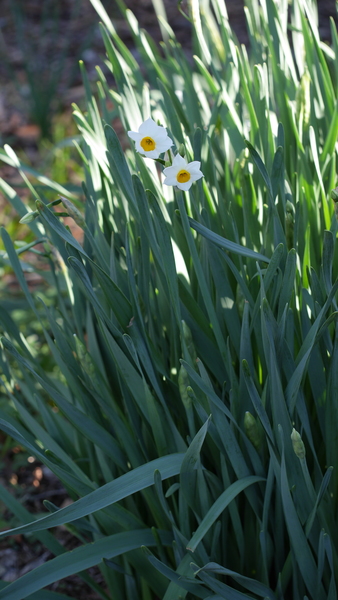
Narcissus tazetta var. chinensis (paperwhite, "Suisen")
Japanese name: スイセン (水仙)
Scientific name: Narcissus tazetta var. chinensis
[Overview]
A perennial 20–40 cm tall, found near the coast.
It has a broadly ovate bulb underground.
The leaves are basal simple leaves, flat, linear to strap-shaped, 20–40 cm long and 0.8–1.6 cm wide, with rounded tips.
The leaves are green tinged with powdery white.
4–6 leaves emerge in winter, die back in early summer, and the plant is dormant in summer.
The leaves and flower stalk emerge at almost the same time.
An umbel emerges at the tip of a flower stalk 20–40 cm tall and bears 5–8 flowers.
The inflorescence has membranous bracts.
The flowers are 3–4 cm across; the 6 tepals are white, about 1.5 cm long and spread almost flat, and the corona is yellow and cup-shaped, about half the length of the tepals.
The flowers are fragrant.
It does not set fruit.
[History]
It is a form of the bunch-flowered narcissus native to the Mediterranean coastal region, and is thought to have come to Japan from China in ancient times via the Silk Road and then become naturalized.
[Cultivation]
Propagate by dividing the bulbs.
It is not particular about soil as long as the site is sunny and well drained.
In heavy soil such as clay, mix in sand, peat moss or the like.
If planting in the ground and leaving it undisturbed, a spot under deciduous trees or similar is suitable.
For potted plants, water thoroughly when the soil surface dries, and hold back during dormancy.
For plants in the ground, rainfall is sufficient.
Apply compost or slow-release fertilizer as a base fertilizer, and also apply a fertilizer high in phosphorus and potassium around February and after flowering.
Pests and diseases include basal rot, mosaic disease, aphids, nematodes and bulb mites.
Details
Japanese: スイセン(水仙)、ニホンズイセン(日本水仙)
Translated from our Japanese encyclopedia. If anything differs, the Japanese page is correct.