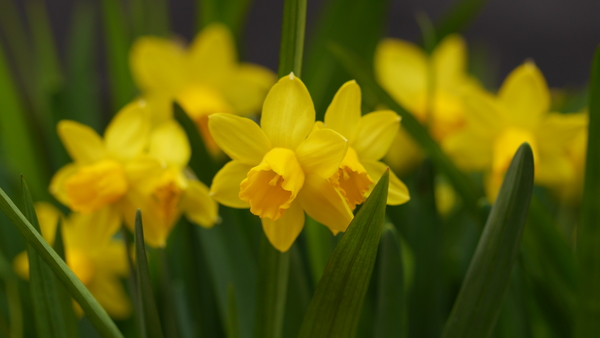
[Overview]
A perennial.
It has bulbs underground.
The leaves are simple basal leaves, linear to strap-shaped; one to several appear in winter, die back in early summer, and the plant is dormant in summer.
The flowers are borne singly or several in an umbel at the tip of the flower stalk, are white or yellow, and are characterized by a corona developed into a cup to trumpet shape.
The flowers are sometimes fragrant.
There are diverse cultivars, such as cluster-flowered and trumpet-flowered, classified into 12 divisions.
[Cultivation]
Propagate mainly by dividing bulbs.
It is not particular about soil as long as the site is sunny and well drained.
For heavy soil such as clay, mix in sand or peat moss.
If planted in the ground and left in place, a site under deciduous trees is suitable.
For potted plants, water thoroughly when the soil surface dries, and hold back during dormancy.
For plants in the ground, rainfall is sufficient.
Apply compost or slow-release fertilizer as a base fertilizer, and also apply a fertilizer high in phosphorus and potassium around February and after flowering.
Pests and diseases include basal rot, mosaic disease, aphids, nematodes and bulb mites.