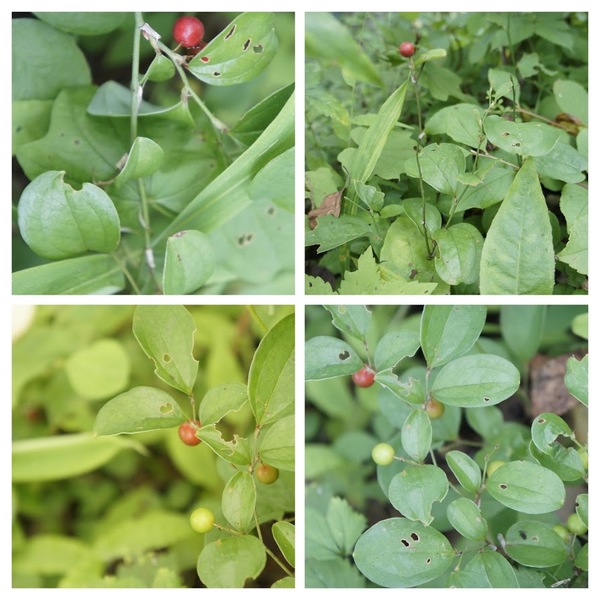
Japanese name: サルマメ(猿豆) Scientific name:Smilax biflora var. trinervula
[Overview]
A deciduous low shrub 30–50 cm tall, growing in the mountains.
The rhizome branches.
The stem branches sparsely and has almost no thorns.
Leaves are simple and alternate, elliptic, 1.5–3 cm long, with 3–5 conspicuous veins.
The leaf margin is entire.
Tendrils are absent or very short.
The leaves turn yellow in autumn.
It is dioecious.
Both male and female flowers are borne 1–3 per umbel arising from the leaf axils, and are pale yellowish-green with 6 tepals.
The fruit is a spherical berry 5 mm in diameter, ripening red.
[Cultivation]
Propagate by division or from seed.
Plants grown from seed will include both males and females.
It prefers a sunny site with well-drained, moisture-retentive soil.
For potted plants, water thoroughly when the soil surface dries; for plants in the ground, rainfall is sufficient unless sunny weather continues and the soil becomes severely dry.
From spring to autumn, apply slow-release fertilizer placed on the soil.
There are no particular pests or diseases.