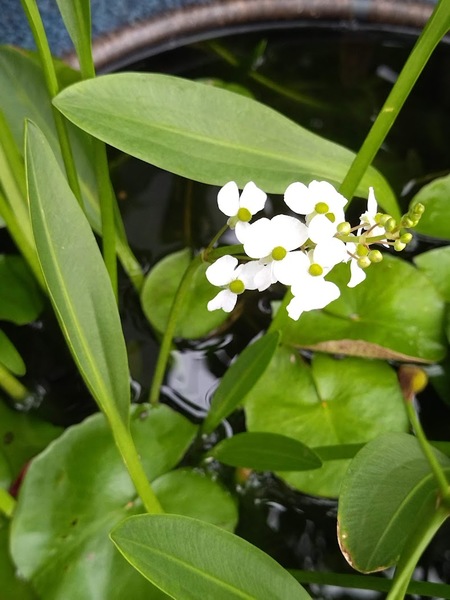
Japanese name: ナガバオモダカ(長葉面高) Scientific name:Sagittaria graminea
[Overview]
An emergent perennial 20–70 cm tall, growing in shallow water in rice paddies, ponds and wetlands.
The plant height varies with water depth and may be even greater.
It produces stolons and forms daughter plants.
The leaves are basal, and both submerged and emergent leaves are produced; the submerged leaves are linear, 10–25 cm long and 1–2.5 cm wide.
The emergent leaves are lanceolate, 7–25 cm long and 1.5–3 cm wide, dark green, and have petioles.
It is dioecious, but only female plants are found in Japan.
A panicle at the tip of the flower stalk bears white 3-petaled flowers about 1.5 cm across, in whorls of 3.
The fruit is an achene, but fruiting is not seen in Japan.
It overwinters as submerged leaves.
[History]
It was discovered in the 1970s at Mizorogaike in Kyoto and reported by Shiro Kitamura.
[Cultivation]
Propagate by division.
Use heavy soil such as Arakida soil and plant in a sunny place.
Keep the roots always submerged.
From spring to autumn, bury oil cake in the soil as fertilizer.
There are no particular pests or diseases.