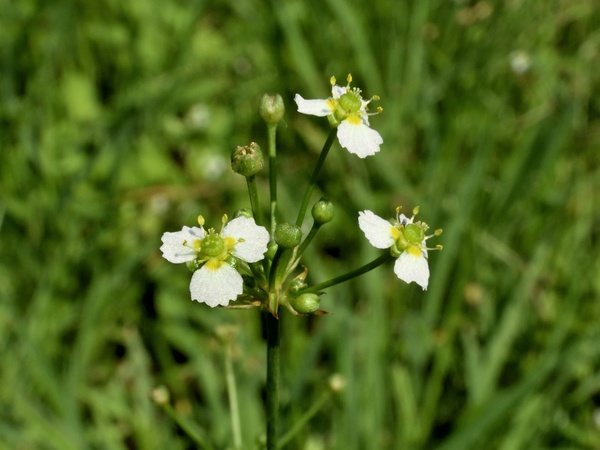
Alisma canaliculatum var. canaliculatum(channelled water plantain, "Heraomodaka")
Japanese name: ヘラオモダカ(箆面高) Scientific name:Alisma canaliculatum var. canaliculatum
[Overview]
An emergent perennial 0.3–1.2 m tall, growing in shallow water in rice paddies, ponds, marshes and wetlands.
It has tubers.
The leaves grow from the base and are only emergent leaves, though it rarely produces linear, stalkless submerged leaves.
The emergent leaves are narrowly oblong, 5–50 cm long and 2–4 cm wide, spatulate, gradually narrowing at both ends.
They have long leaf stalks, and the boundary between leaf and leaf stalk is indistinct.
A panicle at the tip of the flower stalk bears three or more secondary flower stalks arising from the first node of the flower stalk.
The flowers are white and 3-petaled, with the petal bases yellow and the margins wavy-toothed.
The anthers are yellow.
The fruit is an achene.
[Uses]
In China, the whole plant is used medicinally.
[Cultivation]
Propagate from seed.
Use heavy soil such as Arakida soil and plant in a sunny place.
Keep the roots always submerged in water, with the water depth at most about 10 cm.
From spring to autumn, bury oil cake in the soil as fertilizer.
There are no particular pests or diseases.