
Plant Encyclopedia

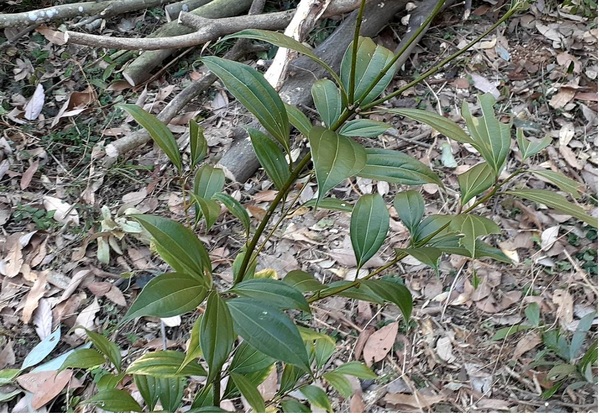
Cinnamomum sieboldii ("Nikkei")
Japanese name: ニッケイ (肉桂)
Scientific name: Cinnamomum sieboldii
[Overview]
An evergreen tree.
Young branches are ridged and at first have grayish-white appressed hairs.
Leaves are simple and alternate, ovate-narrowly oblong to narrowly oblong, 8–15 cm long and 2.5–5 cm wide, with a sharply long-pointed tip and entire margins.
The leaves are at first densely covered with grayish-white appressed hairs, but later the upper surface becomes hairless and glossy, while hairs remain on the underside, which is tinged powdery white.
Three veins are conspicuous on the leaf, and the veins on both sides run parallel to the midrib almost to the tip.
The leaf stalk is 0.8–1.5 cm long.
Much-branched inflorescences arise from the leaf axils of new shoots and bear grayish-white appressed hairs.
The flowers are small and pale yellowish green.
The fruit is an ellipsoid berry 1.1 cm long, ripening blackish purple.
[Uses]
The root bark was once used medicinally as a substitute for keihi (cinnamon bark), and as "nikki" it was used to flavor sweets such as nikki candy and nikki-mizu (nikki water).
It was cultivated from the Edo period, but is hardly cultivated at present.
[Cultivation]
Propagate from seed.
The germination rate drops if the seeds dry out, so take ripe fruits, wash off the pulp thoroughly, and sow immediately, or store the seeds without letting them dry and sow in spring.
The suitable planting area is warm regions from southern Kanto southward, and young seedlings in particular are vulnerable to cold.
It prefers sunny, well-drained, humus-rich soil with moderate moisture, but is not particular about soil unless it is extremely poor.
Because it becomes a large tree, it needs plenty of space.
It is vulnerable to strong wind and snow, and large branches easily break and the tree shape is easily disturbed.
It is also sensitive to pruning, and especially dislikes hard pruning from autumn (the approach of the cold season).
Where space is limited, thin out branches to maintain the tree shape.
There are no particular pests or diseases.
Details
Translated from our Japanese encyclopedia. If anything differs, the Japanese page is correct.