
Plant Encyclopedia

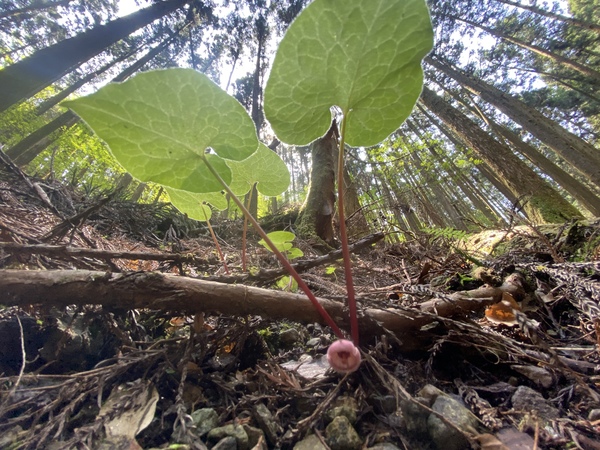
Asarum caulescens ("Futabaaoi")
Japanese name: フタバアオイ (双葉葵、二葉葵)
Scientific name: Asarum caulescens
[Overview]
A perennial seen in forests such as beech forests in the mountains, growing in colonies.
The stem is long and creeps along the ground.
The leaves have long stalks and usually appear two at a time, nearly opposite, at the stem tip; they are cordate-ovate, 4–8 cm long, thin and soft, with a pointed tip and a deeply heart-shaped base, and long hairs grow in regular rows along the margin.
The flowers bloom at almost the same time as the leaves emerge, one in each leaf axil, facing downward.
The flowers are pale reddish purple to pale red and have no petals; the upper part of the calyx tube splits into 3 petal-like lobes, but the lobes are strongly recurved and attached to the calyx tube, so the flower becomes bowl-shaped.
The flower stalk has long hairs.
Inside the calyx tube there are 15 purplish lines; there are 12 stamens, the styles are fused into a column, and there are 6 stigmas spreading radially.
[Uses]
At the Aoi Festival in Kyoto, it is used together with katsura in a decoration called "Aoi-katsura".
It is also the sacred crest of Kamo Shrine and the origin of the crest of the Tokugawa family.
[Cultivation]
Propagate by division.
It prefers bright shade to shade and well-drained soil.
For plants in the ground, it is best planted under deciduous trees.
For potted plants, water thoroughly after the soil surface has dried; for plants in the ground, rainfall is sufficient unless sunny weather continues and the soil dries out.
Fertilize sparingly, applying a small amount of slow-release fertilizer placed on the soil in spring and autumn.
Pests and diseases include southern blight, soft rot, anthracnose, viral disease, slugs and armyworms.
Details
Translated from our Japanese encyclopedia. If anything differs, the Japanese page is correct.