
Plant Encyclopedia

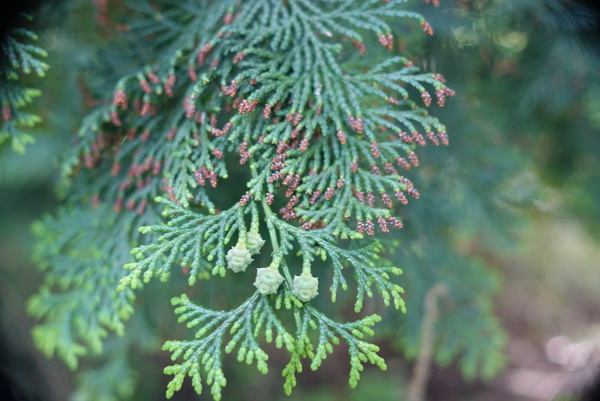
Chamaecyparis pisifera (sawara cypress)
Japanese name: サワラ (椹)
Scientific name: Chamaecyparis pisifera
[Overview]
An evergreen coniferous tree growing to about 30 m tall, found in moist places such as along streams.
The crown is pyramidal.
The trunk is erect, and the bark splits lengthwise and peels off in long, thin strips.
The leaves are in decussate pairs, scale-like, about 3 mm long, with sharply pointed tips, and are aromatic.
The leaf tips curve outward, and on the underside the white stomatal bands, which look like an X, are conspicuous.
In the similar hinoki the stomatal bands are Y-shaped.
Both male and female flowers are borne at the tips of twigs; the male flowers are elliptical and release a great deal of pollen.
The female flowers are spherical.
The cones are spherical, 5–7 mm across, and ripen in autumn.
The seeds are about 2.5 mm and have a wing on each side.
[Uses]
The wood is softer than that of hinoki and so is not suited to construction, but because it resists moisture it is used for bathtubs and bent-wood articles.
There are many cultivars, which are used as garden trees and hedges.
It is widely planted for timber together with hinoki.
It is one of the Kiso Goboku (five trees of Kiso).
[Cultivation]
Propagate from seed or by cuttings.
It prefers a sunny, well-drained site.
It is less tolerant of dryness than hinoki and prefers somewhat moist soil.
It tolerates air pollution and shade.
It grows quickly and tolerates pruning.
In cold regions it may die back from cold winter winds, so it is best planted where it is sheltered from winter monsoon winds.
[Notes]
The Japanese name is an abbreviation of "sawara-ki" and is said to come from its being sawaraka (light and soft) compared with hinoki.
Details
Japanese: サワラ(椹)
Translated from our Japanese encyclopedia. If anything differs, the Japanese page is correct.