
Plant Encyclopedia

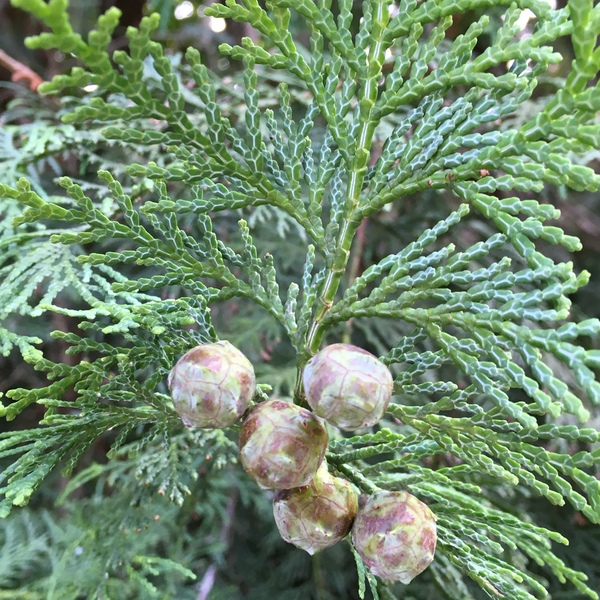
Chamaecyparis obtusa var. obtusa (hinoki cypress)
Japanese name: ヒノキ (檜)
Scientific name: Chamaecyparis obtusa var. obtusa
[Overview]
An evergreen coniferous tree growing to about 30 m tall.
The crown is conical.
The trunk is erect, and the bark splits vertically and peels off in long, thin strips.
The leaves are cross-opposite, scale-like, about 3 mm long, blunt at the tip, and fragrant.
On the underside of the leaves there are white stomatal bands that look Y-shaped.
In the similar Sawara, the stomatal bands are X-shaped.
Both male and female flowers are borne at the tips of twigs; the male flowers are elliptical and release a large amount of pollen.
The female flowers are spherical.
The cones are spherical, 8–12 mm across, and ripen in autumn.
The seeds are about 3 mm long and have wings on both sides.
[Uses]
Together with Sugi, it is an important forestry tree.
The wood, which has a distinctive fragrance, is regarded as the best for construction and is used in a wide range of ways, including for ships, carving and utensils.
The bark is used for the roofs of shrines and temples (hiwadabuki, cypress-bark roofing).
[Cultivation]
Propagate from seed or cuttings.
It prefers a sunny, well-drained place.
It tolerates air pollution and shade.
It grows fast and tolerates clipping.
In cold regions it may die from cold winter winds, so it is preferable to plant it in a place sheltered from the winter monsoon.
[Notes]
The Japanese name Hinoki ("tree of fire") is said to derive from its having been used in the past as the fire-drilling board (hikiri-ita) when making fire by rubbing a stick against it.
Details
Japanese: ヒノキ(檜)
Translated from our Japanese encyclopedia. If anything differs, the Japanese page is correct.