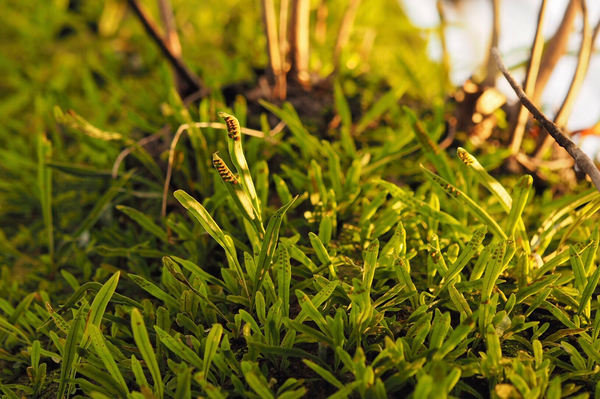
Japanese name: ノキシノブ(軒忍) Scientific name:Lepisorus thunbergianus
[Overview]
An evergreen fern that grows epiphytically on trees and rocks, and can also be seen on stone walls and garden trees around houses.
A rhizome 2–3 mm in diameter, covered with blackish brown scales, creeps horizontally.
The leaves emerge from the rhizome; they are linear, 12–30 cm long and 0.5–1.5 cm wide, somewhat fleshy and leathery.
The leaf surface is dark green, the midrib (main vein) is slightly raised on both sides, and the leaf veins are not visible.
The leaf margins are entire.
There is a leaf stalk 1–3 cm long that is hard to distinguish from the leaf.
During prolonged dryness the leaf margins curl toward the underside and shrivel, but they return to normal when the leaf takes up water.
The sori are yellowish brown and round, on the upper half of the leaf, arranged in one row on each side midway between the midrib (main vein) and the leaf margin.
[History]
Because the leaves show many variations such as shishi-ba (lion-leaf forms), it was cultivated as a traditional horticultural plant and enjoyed a cultivation boom from the Edo period to the Meiji period.
[Uses]
The whole plant is used medicinally.
[Cultivation]
Propagate by division.
It prefers sun to partial shade and an environment with high air humidity.
Japan (southern Hokkaido to Ryukyu), southern Korea, China, Taiwan, Indochina, Philippines
Leaf shape
Linear
Leaf color
Green
Availability of seeds and plants
Low
Form sold
Seedlings
Propagation
Division
Sun exposure
Full sun, Partial shade
Water needs
Moist
Soil needs
Required, Sphagnum moss, Not required
Suitable uses
Wall greening
Uses
Medicinal
Japanese culture
Because the leaves show many variations such as shishi-ba (lion leaf), there was a cultivation boom as a traditional horticultural plant from the Edo period to the Meiji period.
Japan Flower Trade Code
22973
Translated from our Japanese encyclopedia. If anything differs, the Japanese page is correct.