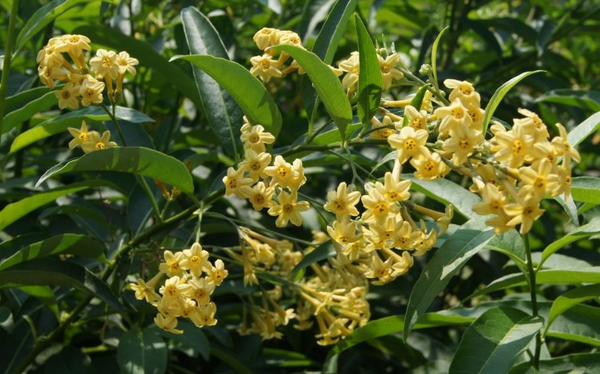
Japanese name: キチョウジ(黄丁子) Scientific name:Cestrum aurantiacum
[Overview]
An evergreen shrub 1–5 m tall, though it may also be vine-like.
It branches well, and the branches are either upright or arching with drooping tips.
The leaves are simple and alternate, elliptic to ovate, about 7–10 cm long and 3.5–5 cm wide, with pointed tips and entire margins.
Panicle-like racemes are produced in the leaf axils and at the stem tips.
The flowers are tubular, about 2.5 cm long, yellow to orange, and the corolla tip is 5-lobed.
The flowers give off a citrus-like fragrance at night.
The fruit is a spherical berry about 1 cm across, ripening white.
[Cultivation]
Propagate by cuttings.
It prefers sun to bright shade and well-drained, moist soil.
It drops its leaves in severe cold, but even if the above-ground part dies back, it will sprout again in spring as long as the roots do not freeze.
In a greenhouse it flowers even in winter.
From spring to autumn, water thoroughly when the soil surface dries; in winter keep it on the dry side.
From spring to autumn, apply slow-release fertilizer placed on the soil.
Pests and diseases include scale insects and aphids.